A thin metal plate $P$ is inserted half way between the plates of a parallel plate capacitor of capacitance $C$ in such a way that it is parallel to the two plates. The capacitance now becomes
Easy
Download our app for free and get started
(a) Thin metal plates doesn't affect the capacitance.

Download our appand get started for free
Experience the future of education. Simply download our apps or reach out to us for more information. Let's shape the future of learning together!No signup needed.*
Similar Questions
- 1View SolutionA hollow closed conductor of irregular shape is given some charge. Which of the following statements are correct ?
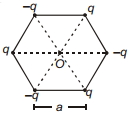
- 2Six point charges are placed at the vertices of a regular hexagon of side $a$ as shown. If $E$ represents electric field and $V$ represents electric potential at $O$, thenView Solution
- 3A dielectric slab of thickness $d$ is inserted in a parallel plate capacitor whose negative plate is at $x = 0$ and positive plate is at $x = 3d$. The slab is equidistant from the plates. The capacitor is given some charge. As one goes from $0$ to $3d$View Solution
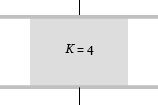
- 4Consider a parallel plate capacitor of $10\,\mu \,F$ (micro-farad) with air filled in the gap between the plates. Now one half of the space between the plates is filled with a dielectric of dielectric constant $4$, as shown in the figure. The capacity of the capacitor changes to.......$\mu \,F$View Solution
- 5The electric potential at a point in free space due to charge $Q$ coulomb is $V=Q$$ \times {10^{11}}\,V$ . The electric field at that point isView Solution
- 6A capacitor of capacitance $6\,\mu \,F$ is charged upto $100$ $volt$. The energy stored in the capacitor is........$Joule$View Solution
- 7A bullet of mass $2\, gm$ is having a charge of $2\,\mu C$. Through what potential difference must it be accelerated, starting from rest, to acquire a speed of $10\,m/s$View Solution
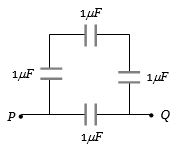
- 8Four capacitors are connected as shown in the equivalent capacitance between the points $P$ and $Q$ is.......$\mu F$View Solution
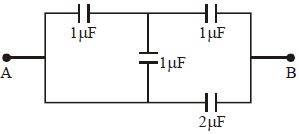
- 9The equivalent capacitance between points $A$ and $B$ of the circuit shown will beView Solution
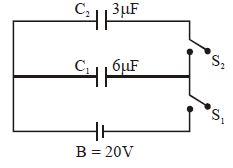
- 10In the circuit shown here $C_1 = 6\,\mu F, C_2 = 3 \,\mu F$ and battery $B = 20\,V$. The switch $S_1$ is first closed. It is then opened and afterwards $S_2$ is closed. What is the charge (in $\mu F$)finally on $C_2$ ?View Solution