Question
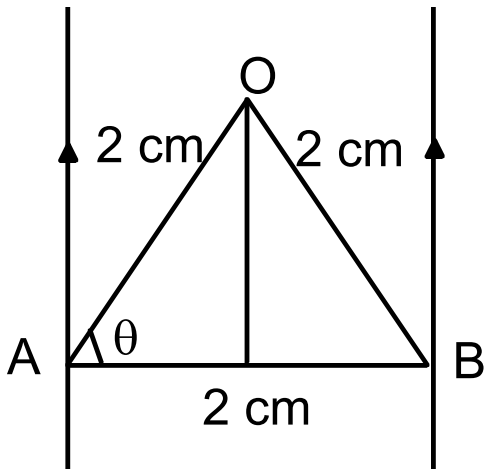
Two parallel wires carry equal currents of 10A along the same direction and are separated by a distance of 2.0cm. Find the magnetic field at a point which is 2.0cm away from each of these wires
Answer


$\cos\theta=\frac{1}{2},$

$\theta=60^\circ\ \&\ \angle\text{AOB}=60^\circ$

$\text{B}=\frac{\mu_0\text{I}}{2\pi\text{r}}=\frac{10^{-7}\times2\times10}{2\times10^{-2}}=10^{-4}\text{T}$

So net is $[(10^{-4})^2]+(10^{-4})^2+2(10^{-8})\cos60^\circ]^\frac{1}{2}$

$=10^{-4}\Big[1+1+2\times\frac{1}{2}\Big]^\frac{1}{2}$

$=10^{-4}\times\sqrt3\text{T}$

$=1.732\times10^{-4}\text{T}$

Need a full question paper?

Generate a complete, print-ready paper with questions like this in minutes — across 16+ boards, with answer keys.
Start Generating Free

Similar questions

A body of mass 'M' at rest is struck by a body of mass 'm'. Show that the fraction of K.E. of mass m transferred to the struck particle is $\frac{4\text{mM}}{(\text{m}+\text{M})^2}.$
A cylinder of length 20cm and radius 10cm is rotating about its central axis at an angular speed of 100rad/s. What tangential force will stop the cylinder at a uniform rate in 10 seconds? The moment of inertia of the cylinder about its axis of rotation is 0.8kgm2.
A uniformly moving cricket ball is turned back by hitting it with a bat for a very short time interval. Show the variation of its acceleration with time. (Take acceleration in the backward direction as positive).
A rod of mass m and length L, lying horizontally, is free to rotate about a vertical axis through its centre. A horizontal force of constant magnitude F acts on the rod at a distance of $\frac{\text{L}}{4}$ from the centre. The force is always perpendicular to the rod. Find the angle rotated by the rod during the time (t) after the motion starts.
Three moles of a diatomic gas is mixed with two moles of monoatomic gas. What will be the molecular specific heat of the mixture at constant volume? [given, R = 8.31J-mol-1K-1]
The. wire ABC shown in figure forms an equilateral triangle. Find the magnetic field B at the centre O of the triangle assuming the wire to be uniform.

Consider Galileo's method of measuring the speed of light using two lanterns. To get an accuracy of about 10%, the time taken by the experimenter in closing or opening the shutter should be about one tenth of the time taken by the light in going from one experimenter to the other. Assume that it takes $\frac{1}{100}$ second for an experimenter to close or open the shutter. How far should the two experimenters be to get a 10% accuracy? What are the difficulties in having this separation?
A man of mass 70kg stands on a weighing scale in a lift which is moving.
What would be the reading if the lift mechanism failed and it hurtled down freely under gravity?
From the top of a tower 100m in height, a ball is dropped and at the same time another ball is projected vertically upwards from the ground with a velocity of 25ms-1. Find when and where the two balls will meet? g = 9.8ms-2?
Two parallel rail tracks run north-south. Train A moves due north with a speed of 54km/ h-1 and train B moves due south with a speed of 90km/ h-1. What is the relative velocity of B with respect to A in m s-1?