To convert a $800\, mV$ range milli voltmeter of resistance $40 \,\Omega$ into a galvanometer of $100\, mA$ range, the resistance to be connected as shunt is .............. $\Omega $
Medium


Download our appand get started for free
Experience the future of education. Simply download our apps or reach out to us for more information. Let's shape the future of learning together!No signup needed.*
Similar Questions
- 1A $100\, ohm$ galvanometer gives full scale deflection at $10\, mA$. How much shunt is required to read $100\, mA$ .............. $ohm$View Solution
- 2A coil having $100$ turns, area of $5 \times 10^{-3} \mathrm{~m}^2$, carrying current of $1 \mathrm{~mA}$ is placed in uniform magnetic field of $0.20 \mathrm{~T}$ such a way that plane of coil is perpendicular to the magnetic field. The work done in turning the coil through $90^{\circ}$ is . . . . . . $\mu \mathrm{J}$.View Solution
- 3Assertion : A proton and an alpha particle having the same kinetic energy are moving in circular paths in a uniform magnetic field. The radii of their circular paths will be equal.View Solution
Reason : Any two charged particles having equal kinetic energies and entering a region of uniform magnetic field $\overrightarrow B $ in a direction perpendicular to $\overrightarrow B $, will describe circular trajectories of equal radii.
- 4A voltmeter of resistance $1000\,\Omega $ gives full scale deflection when a current of $100\, mA$ flow through it. The shunt resistance required across it to enable it to be used as an ammeter reading $1\, A$ at full scale deflection is ............... $\Omega $View Solution
- 5A current of $0.1\, A$ circulates around a coil of $100$ $turns$ and having a radius equal to $5\, cm$. The magnetic field set up at the centre of the coil is $({\mu _0} = 4\pi \times {10^{ - 7}}\,weber/ampere - metre)$View Solution
- 6If current flowing through shell of previous objective is equal to $i$, then energy density at a point distance $2R$ from axis of the shell varies according to the graphView Solution
- 7The coil in a moving coil galvanometer experiences torque proportional to current passes through it. If a steady current $i$ is passed through it the steady deflection of the coil is found to be $90^o$ . Now the steady current is switched off and a charge $q$ is suddenly passed through coil. If the coil has $N$ turns of area $A$ and its moment of inertia is $I$ about the axis it is going to rotate then the maximum angle through which it deflects upon passing charge $q$ isView Solution
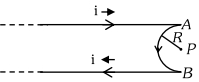
- 8A very long conducting wire is bent in a semicircular shape from $A$ to $B$ as shown in figure. The magnetic field at point $P$ for steady current configuration is given by:View Solution
- 9When a resistance of $5\,\Omega$ is shunted with a moving coil galvanometer, it shows a full scale deflection for a current of $250\,mA$, however when $1050\,\Omega$ resistance is connected with it in series, it gives full scale deflection for $25$ volt. The resistance of galvanometer is $......\,\Omega$.View Solution
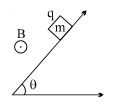
- 10A block of mass $m$ $\&$ charge $q$ is released on a long smooth inclined plane magnetic field $B$ is constant, uniform, horizontal and parallel to surface as shown. Find the time from start when block loses contact with the surface.View Solution