Question
Two particles A and B, each carrying a charge Q, are held fixed with a separation d between them. A particle C having mass m and charge q is kept at the middle point of the line AB.
  1. If it is displaced through a distance x perpendicular to AB, what would be the electric force experienced by it.
  2. Assuming x << d, show that this force is proportional to x.
  3. Under what conditions will the particle C execute simple harmonic motion if it is released after such a small displacement?
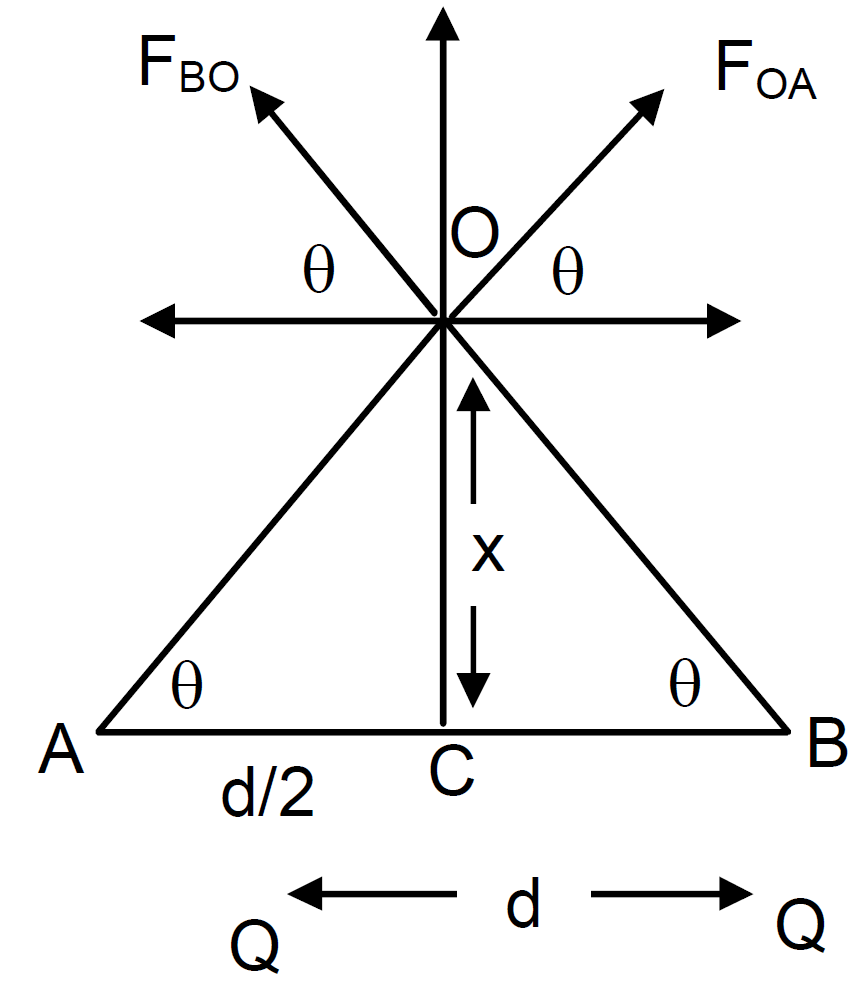
Find the time period of the oscillations if these conditions are satisfied.

Answer


  1. Let Q = charge on A & B Separated by distance d

q = charge on c displaced $\bot$ to -AB

So, force on $0=\overline{\text{F}}_\text{AB}+\overline{\text{F}}_\text{BO}$

But $\text{F}_\text{AO}\cos\theta=\text{F}_\text{BO}\cos\theta$

So, force on ‘0’ in due to vertical component.

$\overline{\text{F}}=\text{F}_\text{AO}\sin\theta+\text{F}_\text{BO}\sin\theta$ $|\text{F}_\text{AO}|=|\text{F}_\text{BO}|$

$=2\frac{\text{KQq}}{\Big(\frac{\text{d}}{2^2+\text{x}^2}\big)}\sin\theta$

$\text{F}=\frac{2\text{KQq}}{\Big(\frac{\text{d}}{2}\Big)^2+\text{x}^2}\sin\theta$

$=\frac{4\times2\times2\text{KQq}}{(\text{d}^2+4\text{x}^2)}\times\frac{\text{x}}{\Big[\big(\frac{\text{d}}{2}\big)^2+\text{x}^2\Big]^{\frac{1}{2}}}$

$=\frac{2\text{kQq}}{\Big[\big(\frac{\text{d}}{2}\big)^2+\text{x}^2\Big]^{\frac{3}{2}}}\text{x}$ = Electric force $\Rightarrow\text{F}\propto\text{x}$

  1. When x << d

$\text{F}=\frac{2\text{kQq}}{\Big[\big(\frac{\text{d}}{2}\big)^2+\text{x}^2\Big]^{\frac{3}{2}}}\text{x}$ x << d

$\Rightarrow\text{F}=\frac{2\text{kQq}}{\Big(\frac{\text{d}^2}{4}\Big)^{\frac{3}{2}}}\text{x}\Rightarrow\text{F}\propto\text{x}$

$\text{a}=\frac{\text{F}}{\text{m}}=\frac{1}{\text{m}}\Bigg[\frac{2\text{kQqx}}{\Big[\big(\frac{\text{d}^2}{4}\big)+\ell^2}\Bigg]$

So time period $\text{T}=2\pi\sqrt{\frac{\ell}{\text{g}}}$

$=2\pi\sqrt{\frac{\ell}{\text{a}}}$

Need a full question paper?

Generate a complete, print-ready paper with questions like this in minutes — across 16+ boards, with answer keys.

Start Generating Free

Similar questions

Find out magnetic force on parallel current carrying conductors and also state their special conditions.
Consider a non-conducting plate of radius r and mass m that has a charge q distributed uniformly over it. The plate is rotated about its axis with an angular speed $\omega.$ Show that the magnetic moment $\mu$ and the angular momentum of the plate are related as $\mu=\frac{\text{q}}{2\text{m}}\text{l}.$
By giving example of bar magnet, explain its basic properties.
A 2kg block is placed over a 4kg block and both are placed on a smooth horizontal surface. The coefficient of friction between the blocks is 0.20. Find the acceleration of the two blocks if a horizontal force of 12N is applied to:
  1. The upper block.
  2. The lower block. Take g = 10m/s2.
  1. For a ray of light travelling from a denser medium of refractive index n1 to a rarer medium of refractive index nprove that  $\frac{\text{n}_{2}}{\text{n}_{1}} = \sin \text{i}_{c} ,$ where ic is the critical angle of incidence for the media.
  2. Explain with the help of a diagram, how the above principle is used for transmission of video signals using optical fibres.

A long cylindrical wire carries a positive charge of linear density 2.0 × 10⁻⁸Cm-1. An electron revolves around it in a circular path under the influence of the attractive electrostatic force. Find the kinetic energy of the electron. Note that it is independent of the radius.
  1. In the explanation of photo electric effect, we asssume one photon of frequency ν collides with an electron and transfers its energy. This leads to the equation for the maximum energy Emax of the emitted electron as,

$\text{E}_\text{max}=\text{hv}-\phi_0$

where $\phi_0$ is the work function of the metal. If an electron absorbs 2 photons (each of frequency ν ) what will be the maximum energy for the emitted electron?

  1. Why is this fact (two photon absorption) not taken into consideration in our discussion of the stopping potential?
A metre scale made of steel reads accurately at 20°C. In a sensitive experiment, distances accurate up to 0.055mm in 1m are required. Find the range of temperature in which the experiment can be performed with this metre scale. Coefficient of linear expansion of steel = 11 × 10-6 °C-1.
A concave mirror forms an image of 20cm high object on a screen placed 5.0m away from the mirror. The height of the image is 50cm. Find the focal length of the mirror and the distance between the mirror and the object.
An electric dipole of dipole moment $\vec{\text{P}}$ is placed in a uniform electric field $\vec{\text{E}}.$ Write the expression for the torque $\vec\tau$ experienced by the dipole. Identify two pairs of perpendicular vectors in the expression. Show diagrammatically the orientation of the dipole in the field for which the torque is (i) Maximum (ii) Half the maximum value (iii) Zero.