Question
A 2kg block is placed over a 4kg block and both are placed on a smooth horizontal surface. The coefficient of friction between the blocks is 0.20. Find the acceleration of the two blocks if a horizontal force of 12N is applied to:
  1. The upper block.
  2. The lower block. Take g = 10m/s2.

Answer

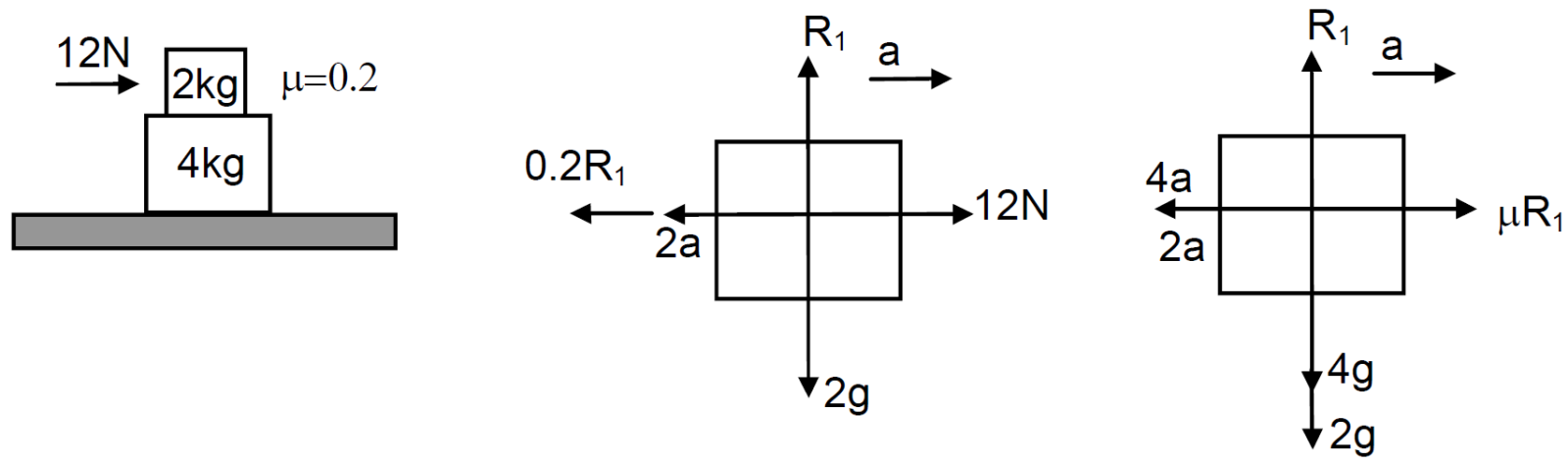
  1.  

R1 - 2g = 0

⇒ R1 = 2 × 10 = 20

2a + 0.2 R1 - 12 = 0

⇒ 2a + 0.2(20) = 12

⇒ 2a = 12 - 4 = 8

⇒ a = 4m/s2

$4\text{a}_1-\mu\text{R}_1=0$

$\Rightarrow4\text{a}_1=\mu\text{R}_1=0.2(20)$

⇒ 4a1 = 4

⇒ a1 = 1m/s2

2kg block has acceleration 4m/s2 & that of 4kg is 1m/s2

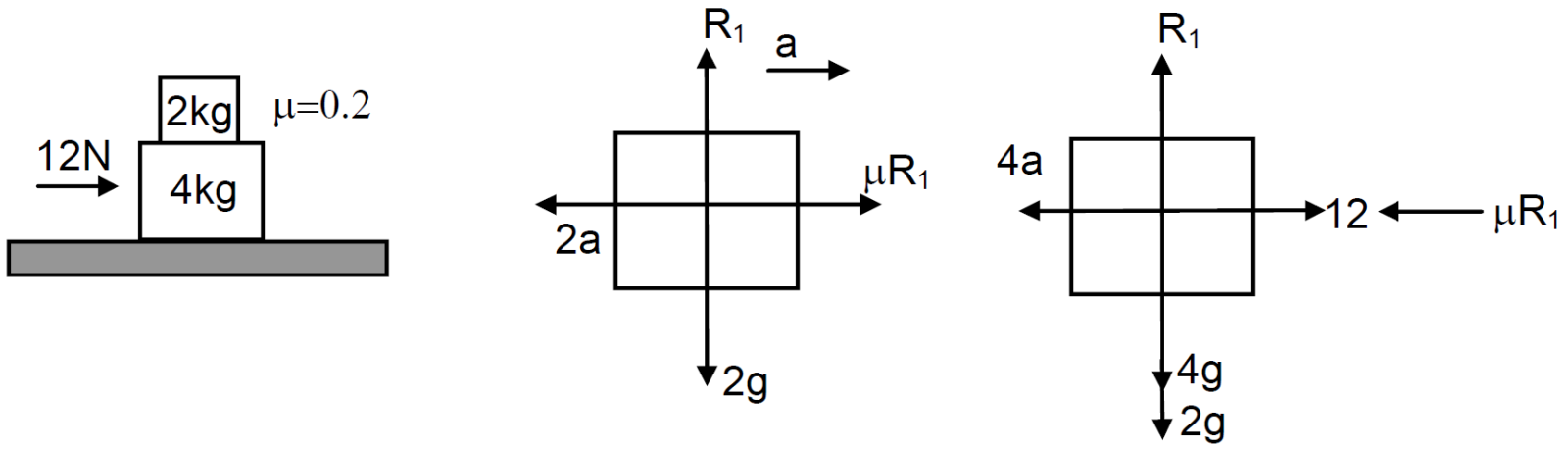
  1.  

R1 = 2g = 20

$\text{Ma}-\mu\text{R}_1=0$

⇒ 2a = 0.2(20) = 4

⇒ a = 2m/s2

4a + 0.2 × 2 × 10 - 12 = 0

⇒ 4a + 4 = 12

⇒ 4a = 8

⇒ a = 2m/s2

Need a full question paper?

Generate a complete, print-ready paper with questions like this in minutes — across 16+ boards, with answer keys.

Start Generating Free

Similar questions

The optical properties of a medium are governed by the relative permitivity $(\in_\text{r})$ and relative permeability $(\mu_\text{r})$. The refractive index is defined as $\sqrt{\mu_\text{r}\in_\text{r}}=\text{n}$.For ordinary material $\in_\text{r}=0\text{ and }\mu_\text{r}<0$ and the positive sign is taken for the square root. In 1964, a Russian scientist V. Veselago postulated the existence of material with $\in_\text{r}=0\text{ and }\mu_\text{r}<0$. Since then such 'metamaterials' have been produced in the laboratories and their optical properties studied. For such materials $\text{n}=-\sqrt{\mu_1\in_1}$. As light enters a medium of such refractive index the phases travel away from the direction of propagation.
  1. According to the description above show that if rays of light enter such a medium from air (refractive index = 1) at an angle ? In 2nd quadrant, them the refracted beam is in the 3rd quadrant.
  2. Prove that Snell's law holds for such a medium.
Potassium-40 can decay in three modes. It can decay by $\beta^-$-emission, $\beta^+$-emission of electron capture.
  1. Write the equations showing the end products.
  2. Find the Q-values in each of the three cases. Atomic masses of $\text{ }^{40}_{18}\text{Ar},\text{ }^{40}_{19}\text{K}$ and $\text{ }^{40}_{20}\text{Ca}$ are 39.9624u 39.9640u and 39.9626u respectively.
An optical instrument used for angular magnification has a 25D objective and a 20D eyepiece. The tube length is 25cm when the eye is least strained.
  1. Whether it is a microscope or a telescope?
  2. What is the angular magnification produced?
Examine the maximum value of magnetic field at a point on the axis of circular current carrying coil after obtaining an expression for it.###Calculate produced magnetic field on the axis of any current carrying circular coil by making diagram. Examine the graph between distance and change in magnetic field after drawing the graph.
  1. Explain, giving reasons, the basic difference in converting a galvanometer into (i) a voltmeter and (ii) an ammeter.
  2. Two long straight parallel conductors carrying steady currents I1 and I2 are separated by a distance 'd'. Explain briefly, with the help of a suitable diagram, how the magnetic field due to one conductor acts on the other. Hence deduce the expression for the force acting between the two conductors. Mention the nature of this force.
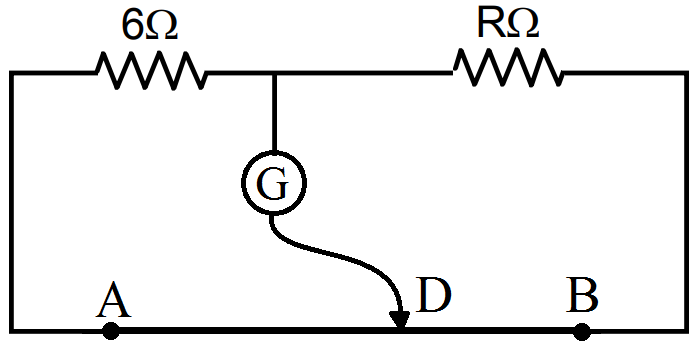
The potentiometer wire AB shown in figure. is 50cm long. When AD = 30cm, no deflection occurs in the galvanometer. Find R.

  1. Plot a graph showing variation of voltage vs the current drawn from the cell. How can one get information from this plot about the emf of the cell and its internal resistance?
  2. Two cells of emf’s E1 and E2 and internal resistance r1 and r2 are connected in parallel. Obtain the expression for the emf and internal resistance of a single equivalent cell that can replace this combination?
The electric field in a region is given by $\overrightarrow{\text{E}}=\frac{\text{E}_0\text{x}}{\text{l}}\vec{\text{i}}.$ Find the charge contained inside a cubical volume bounded by the surfaces x = 0, x = a, y = 0, y = a, z = 0 and z = a. Take E0 = 5 × 10³Nc-1, l = 2cm and a = 1cm.