MCQ
Two particles $A$ and $B$, move with constant velocities ${\vec v_1}$ and ${\vec v_2}$. At the initial moment their position vectors are ${\vec r_1}$ and ${\vec r_2}$ respectively. The condition for their collision is
  • A
    ${\vec r_1} - {\vec r_2} = {\vec v_1} - {\vec v_2}$
  • $\frac{{{{\vec r}_1} - {{\vec r}_2}}}{{\left| {{{\vec r}_1} - {{\vec r}_2}} \right|}} = \frac{{{{\vec v}_2} - {{\vec v}_1}}}{{\left| {{{\vec v}_2} - {{\vec v}_1}} \right|}}$
  • C
    ${{\vec r}_1}.{{\vec v}_1} = {{\vec r}_2}.{{\vec v}_2}$
  • D
    ${{\vec r}_1} \times {{\vec v}_1} = {{\vec r}_2} \times {{\vec v}_2}$
Answer

Correct option: B.
$\frac{{{{\vec r}_1} - {{\vec r}_2}}}{{\left| {{{\vec r}_1} - {{\vec r}_2}} \right|}} = \frac{{{{\vec v}_2} - {{\vec v}_1}}}{{\left| {{{\vec v}_2} - {{\vec v}_1}} \right|}}$
b
For two particles to collide, the direction of the relative velocity of one with respect to other should be directed towands the relative position of the other particle

ie. $\frac{\vec{\mathrm{r}}_{1}-\vec{\mathrm{r}}_{2}}{\left|\vec{\mathrm{r}}_{1}-\vec{\mathrm{r}}_{2}\right|} \rightarrow$ clivection of relative position of $1 \mathrm{w.r.t}$ $2$

 $\frac{\vec{\mathrm{v}}_{2}-\vec{\mathrm{v}}_{1}}{\left|\vec{\mathrm{v}}_{2}-\vec{\mathrm{v}}_{1}\right|} \rightarrow$ direction of velocity of $2 \mathrm{w}$ $r.t. 1$

so for collision of $\mathrm{A} \& \mathrm{B}$

$\frac{\overrightarrow{\mathrm{r}}_{1}-\overrightarrow{\mathrm{r}}_{2}}{\left|\overrightarrow{\mathrm{r}}_{1}-\overrightarrow{\mathrm{r}}_{2}\right|}=\frac{\overrightarrow{\mathrm{v}}_{2}-\overrightarrow{\mathrm{v}}_{1}}{\left|\overrightarrow{\mathrm{v}}_{2}-\overrightarrow{\mathrm{v}}_{1}\right|}$

Need a full question paper?

Generate a complete, print-ready paper with questions like this in minutes — across 16+ boards, with answer keys.

Start Generating Free

Similar questions

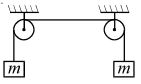
Two identical mass $m$ are connected to a massless string which is hung over two frictionless pulleys as shown in figure. If everything is at rest, what is the tension in the cord?
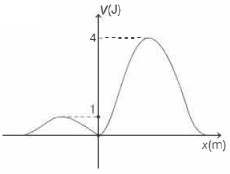
A point particle of mass $0.5 \,kg$ is moving along the $X$-axis under a force described by the potential energy $V$ shown below. It is projected towards the right from the origin with a speed $v$. What is the minimum value of $v$ for which the particle will escape infinitely far away from the origin?
The fundamental frequency of a vibrating organ pipe is $200Hz.$
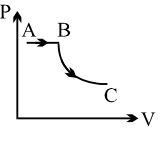
A process is shown in the diagram. Which of the following curves may represent the same process ?
A spherical liquid drop of radius $R$ is divided into eight equal droplets. If surface tension is $T$, then work done in the process will be:
A uniform cube is subjected to volume compression. If each side is decreased by $1\%,$ then bulk strain is
For a body moving in a circular path, a condition for no skidding if $\mu $ is the coefficient of friction, is
Equal torques act on the discs $A$ and $B$ of the previous problem, initially both being at rest. At a later instant, the linear speeds of a point on the rim of $A$ and another point on the rim of $B$ are $v_A$ and $v_B$ respectively. We have:
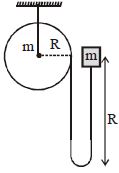
Mass of the pulley is $m$ & radius is $R$. Assume pulley to be uniform disc. Pulley is free to rotate about an axis passing through its centre and perpendicular to its plane. String is massless & inextensible. String is wrapped on the pulley. There is no slipping between string and pulley. The length of the string which is not wrapped on the pulley is $2R$. Block of mass $m$ is released from the position as shown in the figure. The impulse exerted by the string on the pulley at the moment string becomes taut is $J. \frac{2m \sqrt{gR}}{J}$ is equal to.
The heat required to change $1 \,kg$ of ice at $-8^{\circ} C$ into water at $20^{\circ} C$. at $1 \,atm$ of pressure, is closest to .............$\,kJ$ (Assume that ice has a specific heat capacity $2.1 \,kJ / kg / K$. water has a specific heat capacity $4.2 \,kJ / kg / K$, and latent heat of fusion of ice is $333 \,kJ / kg$ )