MCQ
Two particles $A$ and $B,$ move with constant  velocities $\vec v_1$ and $\vec v_2$. At the initial moment their position vectors are $\vec r_1$ and $\vec r_2$ respectively. The condition for particles $A$ and $B$ for their collision is
  • $\frac{{\overrightarrow {{r_1}} - \overrightarrow {{r_2}} }}{{\left| {\overrightarrow {{r_1}} - \overrightarrow {{r_2}} } \right|}} = \;\frac{{\overrightarrow {{v_2}} - \overrightarrow {{v_1}} }}{{\left| {\overrightarrow {{v_2}} - \overrightarrow {{v_1}} } \right|}}\;\;\;$
  • B
    $\overrightarrow {{r_1}} $ -$\overrightarrow {{r_2}} $ = $\overrightarrow {{v_1}} $ -$\overrightarrow {{v_2}} $
  • C
    $\;\overrightarrow {{r_1}} $ .$\;\overrightarrow {{v_1}} $ =$\overrightarrow {{r_2}} $ .$\;\overrightarrow {{v_2}} $
  • D
    $\;\overrightarrow {{r_1}} \times \overrightarrow {{v_1}}=\overrightarrow {{r_2}}  \times \overrightarrow {{v_2}} $
Answer

Correct option: A.
$\frac{{\overrightarrow {{r_1}} - \overrightarrow {{r_2}} }}{{\left| {\overrightarrow {{r_1}} - \overrightarrow {{r_2}} } \right|}} = \;\frac{{\overrightarrow {{v_2}} - \overrightarrow {{v_1}} }}{{\left| {\overrightarrow {{v_2}} - \overrightarrow {{v_1}} } \right|}}\;\;\;$
a
$\begin{array}{l}
\,\,\,\,\,\,\,\,\,\,\,\,\,\,\,\,Let\,the\,particles\,A\,and\,B\,collide\\
at\,time\,t.\,For\,their\,collision,\,the\,position\\
vectors\,of\,both\,particles\,sholud\,be\,\\
same\,at\,time\,t,\,i.e.,\\
{{\vec r}_1} + {{\vec v}_1}t = {{\vec r}_2} + {{\vec v}_2}t\,;\,{{\vec r}_1} - {{\vec r}_2} = {{\vec v}_2}t - {{\vec v}_1}t\\
 = \left( {{{\vec v}_2} - {{\vec v}_1}} \right)t\,\,\,\,\,\,\,\,\,\,\,\,\,\,\,\,\,\,\,\,\,\,\,\,\,\,\,\,\,\,\,\,\,\,\,\,\,\,\,\,\,\,\,\,\,\,...\left( i \right)
\end{array}$

$\begin{array}{l}
Also,\,\left| {\,{{\vec r}_1} - {{\vec r}_2}} \right| = \left| {{{\vec v}_2} - {{\vec v}_1}} \right|t\,\,or\,t = \frac{{\left| {\,{{\vec r}_1} - \vec r} \right|}}{{\left| {{{\vec v}_2} - {{\vec v}_1}} \right|}}\\
Substituting\,this\,value\,of\,t\,in\,eqn.\,\left( i \right),\\
we\,get\,\\
\,\,\,\,\,\,\,\,\,\,\,\,\,\,\,{{\vec r}_1} - {{\vec r}_2} = \left( {{{\vec v}_2} - {{\vec v}_1}} \right)\frac{{\left| {\,{{\vec r}_1} - \vec r} \right|}}{{\left| {{{\vec v}_2} - {{\vec v}_1}} \right|}}\\
or\,\frac{{\left| {\,{{\vec r}_1} - {{\vec r}_2}} \right|}}{{\left| {\,{{\vec r}_1} - {{\vec r}_2}} \right|}} = \frac{{\left( {{{\vec v}_2} - {{\vec v}_1}} \right)}}{{\left| {{{\vec v}_2} - {{\vec v}_1}} \right|}}
\end{array}$

Need a full question paper?

Generate a complete, print-ready paper with questions like this in minutes — across 16+ boards, with answer keys.

Start Generating Free

Similar questions

Who proposed the wave theory?
$Henry/ohm$ can be expressed in
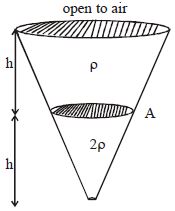
Two immiscible liquid are filled in conical flask as shown in figure. The area of cross section is shown, a small hole of area a is made in lower end of cone. Find speed of liquid flow from hole
The Young's Modulus of elasticity is equal to that stress numerically which :
Sound waves have the following frequencies that are audible to human beings  .... $c/s$
What should be the velocity of earth due to rotation about its own axis so that the weight at equator become $3/5$ of initial value. Radius of earth on equator is $ 6400\, km$
The two ends of a spring are displaced along the length of the spring. All displacement have equal magnitudes. In which case or cases the tension or compression in the spring will have a maximum magnitude?
  1. The right end is displaced towards right and the left end towards left.
  2. Both ends are displaced towards right.
  3. Both ends are displaced towards left.
  4. The right end is displaced towards left and the left end towards right.
Which of the following statements is correct?
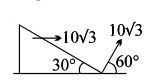
A particle is projected at angle $60^o$ with speed $10\sqrt 3 $, from the point $‘A’$ as shown in the figure. At the same time the wedge is made to move with speed $10\sqrt 3$ towards right as shown in the figure. Then the time after which particle will strike with wedge is  ........ $\sec$
A body is rolling down an inclined plane. If kinetic energy of rotation is $40\%$ of  translational kinetic energy, then the body is a