MCQ
Two particles $A$ and $B,$ move with constant  velocities $\vec v_1$ and $\vec v_2$. At the initial moment their position vectors are $\vec r_1$ and $\vec r_2$ respectively. The condition for particles $A$ and $B$ for their collision is
  • $\frac{{\overrightarrow {{r_1}} - \overrightarrow {{r_2}} }}{{\left| {\overrightarrow {{r_1}} - \overrightarrow {{r_2}} } \right|}} = \;\frac{{\overrightarrow {{v_2}} - \overrightarrow {{v_1}} }}{{\left| {\overrightarrow {{v_2}} - \overrightarrow {{v_1}} } \right|}}\;\;\;$
  • B
    $\overrightarrow {{r_1}} $ -$\overrightarrow {{r_2}} $ = $\overrightarrow {{v_1}} $ -$\overrightarrow {{v_2}} $
  • C
    $\;\overrightarrow {{r_1}} $ .$\;\overrightarrow {{v_1}} $ =$\overrightarrow {{r_2}} $ .$\;\overrightarrow {{v_2}} $
  • D
    $\;\overrightarrow {{r_1}} \times \overrightarrow {{v_1}}=\overrightarrow {{r_2}}  \times \overrightarrow {{v_2}} $
Answer

Correct option: A.
$\frac{{\overrightarrow {{r_1}} - \overrightarrow {{r_2}} }}{{\left| {\overrightarrow {{r_1}} - \overrightarrow {{r_2}} } \right|}} = \;\frac{{\overrightarrow {{v_2}} - \overrightarrow {{v_1}} }}{{\left| {\overrightarrow {{v_2}} - \overrightarrow {{v_1}} } \right|}}\;\;\;$
a
$\begin{array}{l}
\,\,\,\,\,\,\,\,\,\,\,\,\,\,\,\,Let\,the\,particles\,A\,and\,B\,collide\\
at\,time\,t.\,For\,their\,collision,\,the\,position\\
vectors\,of\,both\,particles\,sholud\,be\,\\
same\,at\,time\,t,\,i.e.,\\
{{\vec r}_1} + {{\vec v}_1}t = {{\vec r}_2} + {{\vec v}_2}t\,;\,{{\vec r}_1} - {{\vec r}_2} = {{\vec v}_2}t - {{\vec v}_1}t\\
 = \left( {{{\vec v}_2} - {{\vec v}_1}} \right)t\,\,\,\,\,\,\,\,\,\,\,\,\,\,\,\,\,\,\,\,\,\,\,\,\,\,\,\,\,\,\,\,\,\,\,\,\,\,\,\,\,\,\,\,\,\,...\left( i \right)
\end{array}$

$\begin{array}{l}
Also,\,\left| {\,{{\vec r}_1} - {{\vec r}_2}} \right| = \left| {{{\vec v}_2} - {{\vec v}_1}} \right|t\,\,or\,t = \frac{{\left| {\,{{\vec r}_1} - \vec r} \right|}}{{\left| {{{\vec v}_2} - {{\vec v}_1}} \right|}}\\
Substituting\,this\,value\,of\,t\,in\,eqn.\,\left( i \right),\\
we\,get\,\\
\,\,\,\,\,\,\,\,\,\,\,\,\,\,\,{{\vec r}_1} - {{\vec r}_2} = \left( {{{\vec v}_2} - {{\vec v}_1}} \right)\frac{{\left| {\,{{\vec r}_1} - \vec r} \right|}}{{\left| {{{\vec v}_2} - {{\vec v}_1}} \right|}}\\
or\,\frac{{\left| {\,{{\vec r}_1} - {{\vec r}_2}} \right|}}{{\left| {\,{{\vec r}_1} - {{\vec r}_2}} \right|}} = \frac{{\left( {{{\vec v}_2} - {{\vec v}_1}} \right)}}{{\left| {{{\vec v}_2} - {{\vec v}_1}} \right|}}
\end{array}$

Need a full question paper?

Generate a complete, print-ready paper with questions like this in minutes — across 16+ boards, with answer keys.

Start Generating Free

Similar questions

In a uniform electric field, a cube of side $1\ cm$ is placed. The total energy stored in the cube is $8.85\ μJ$ . The electric field is parallel to four of the faces of the cube. The electric flux through any one of the remaining two faces is
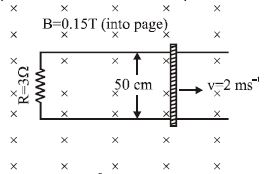
As shown in the figure, a metal rod makes contact with a partial circuit and completes the circuit. The circuit area is perpendicular to a magnetic field with $B = 0.15\, T$. If the resistance of the total circuit is $3\,\Omega $, the force needed to move the rod as indicated with a constant speed of $2\, ms^{-1}$ will be equal to:-
The average kinetic energy of hydrogen molecules at $300 K$ is $E.$ At the same temperature, the average kinetic energy of oxygen molecules will be
On sounding tuning fork $A$ with another tuning fork $B$ of frequency $384 Hz, 6$ beats are produced per second. After loading the prongs of $A$ with some wax and then sounding it again with $B, 4$ beats are produced per second. What is the frequency of the tuning fork $A$  .... $Hz$
The electric field intensity at $P$ and $Q$, in the shown arrangement, are in the ratio
If a soap bubble expands, the pressure inside the bubble:
A particle is moving along the $x-$axis with its coordinate with the time '$t$' given be $\mathrm{x}(\mathrm{t})=10+8 \mathrm{t}-3 \mathrm{t}^{2} .$ Another particle is moving the $y-$axis with its coordinate as a function of time given by $\mathrm{y}(\mathrm{t})=5-8 \mathrm{t}^{3} .$ At $\mathrm{t}=1\; \mathrm{s},$ the speed of the second particle as measured in the frame of the first particle is given as $\sqrt{\mathrm{v}} .$ Then $\mathrm{v}$ (in $\mathrm{m} / \mathrm{s})$ is
This question has Statement $1$ and Statement $2.$ Of the four choices given after the Statements, choose the one that best describes the two Statements.

Statement $1 :$ Self inductance of a long solenoid of length $L,$ total number of turns $N$ and radius $r$ is less than $\frac{{\pi {\mu _0}{N^2}{r^2}}}{L}$

Statement $2:$ The magnetic induction in the solenoid in Statement $1$ carrying current $I$ is $\frac{{{\mu _0}NI}}{L}$ in the middle of the solenoid but becomes less as we move towards its ends.

A glass flask contains some mercury at room temperature. It is found that at different temperatures the volume of air inside the flask remains the same. If the volume of mercury in the flask is $300 \,\,cm^3$, then volume of the flask is ........ $cm^3$. (given that coefficient of volume expansion of mercury and coefficient of linear expansion of glass are $1.8 × 10^{-4} (^o C)^{-1}$ and $9 × 10^{-6} (^o C)^{-1}$ respectively)
A particle moves with constant angular velocity in circular path of certain radius and is acted upon by a certain centripetal force $F$. if the centripetal force $F$ is kept constant but the angular velocity is doubled, the new radius of the path (original radius $R$ ) will be