MCQ
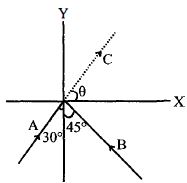
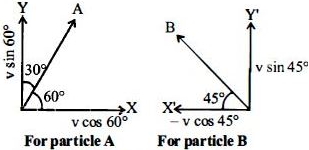
Two particles $A$ and $B$ of equal mass $M$ are moving with the same speed $v$ as shown in the figure . They collide completely inelastically and move as a single particle $C$. The angle $\theta $ that the path of $C$ makes with the $X-$ axis is given by 
  • $\tan \theta  = \frac{{\sqrt 3  + \sqrt 2 }}{{1 - \sqrt 2 }}$
  • B
    $\tan \theta  = \frac{{\sqrt 3  - \sqrt 2 }}{{1 - \sqrt 2 }}$
  • C
    $\tan \theta  = \frac{{1 - \sqrt 2 }}{{\sqrt 2 \left( {1 + \sqrt 3 } \right)}}$
  • D
    $\tan \theta  = \frac{{1 - \sqrt 3 }}{{1 + \sqrt 2 }}$
Answer

Correct option: A.
$\tan \theta  = \frac{{\sqrt 3  + \sqrt 2 }}{{1 - \sqrt 2 }}$
a
For particle $C,$

According to law of conservation of linear momentum, verticle component,

$2\,mv'\,\sin \,\theta  = mv\sin {60^ \circ } + mv\,\sin {45^ \circ }$

$2mv'\sin \theta  = \frac{{mv}}{{\sqrt 2 }} + \frac{{mv\sqrt 3 }}{2}\,\,\,\,\,\,\,\,\,\,\,\,\,...\left( i \right)$

Horizonatal component,

$2\,mv'\,\sin \,\theta  = mv\sin {60^ \circ } - mv\,\sin {45^ \circ }$

$2mv'\cos \theta  = \frac{{mv}}{2} + \frac{{mv}}{{\sqrt 2 }}\,\,\,\,\,\,...\left( {ii} \right)$

Dividing $e{q^n}$ $(i)$ by $e{q^n}$ $(ii),$

$\tan \theta  = \frac{{\frac{1}{{\sqrt 2 }} + \frac{{\sqrt 3 }}{2}}}{{\frac{1}{2} - \frac{1}{{\sqrt 2 }}}} = \frac{{\sqrt 2  + \sqrt 3 }}{{1 - \sqrt 2 }}$

Need a full question paper?

Generate a complete, print-ready paper with questions like this in minutes — across 16+ boards, with answer keys.

Start Generating Free

Similar questions

A neutron moving with a speed $'v'$ makes a head on collision with a stationary hydrogen atom in ground state . The minimum kinetic energy of the neutron for which inelastic collision will take place is....$eV$
A metal rod of Young's modulus $Y$ and coefficient of thermal expansion $\alpha$ is held at its two ends such that its length remains invariant. If its temperature is raised by $t^{\circ} C$, the linear stress developed in it is
The vector product of two vectors a and b is a vector c such that c is perpendicular to the plane containing a and b and the direction is given by:
A satellite in force-free space sweeps stationary interplanetary dust at a rate $\frac{d M}{d t}=\alpha v$ where $M$ is the mass, $v$ is the velocity of the satellite and $\alpha $ is a constant. What is the deacceleration of the satellite
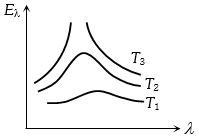
Variation of radiant energy emitted by sun, filament of tungsten lamp and welding arc as a function of its wavelength is shown in figure. Which of the following option is the correct match
When the potential energy of a particle executing simple harmonic motion is one-fourth of its maximum value during the oscillation, the displacement of the particle from the equilibrium position in terms of its amplitude $a$ is
Two sources of sound of same frequency are placed at a distance of $100\,m$ from each  other. An observer moving in between them hears $4$ beats per second. If the distance  between the sound sources is increased to $400\,m$, then number of beats heard by him will be :-
You measure two quantities as $\text{A} = 1.0 \text{m}\pm 0.2 \text{m},\ \text{B} = 2.0 \text{m}\pm 0.2 \text{m}.$ We should report correct value for $\sqrt{\text{AB}}$ as:
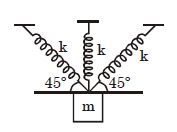
Initially system is in equilibrium. Time period of $SHM$ of block in vertical direction is
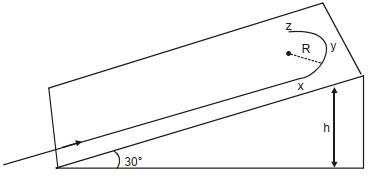
A student skates up a ramp that makes an angle $30^{\circ}$ with the horizontal. $He /$ she starts (as shown in the figure) at the bottom of the ramp with speed $v_0$ and wants to turn around over a semicircular path xyz of radius $R$ during which he/she reaches a maximum height $h$ (at point y) from the ground as shown in the figure. Assume that the energy loss is negligible and the force required for this turn at the highest point is provided by his/her weight only. Then ( $g$ is the acceleration due to gravity)

$(A)$ $v_0^2-2 g h=\frac{1}{2} g R$

$(B)$ $v_0^2-2 g h=\frac{\sqrt{3}}{2} g R$

$(C)$ the centripetal force required at points $x$ and $z$ is zero

$(D)$ the centripetal force required is maximum at points $x$ and $z$