MCQ
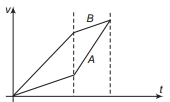
Two particles $A$ and $B$ start from rest and move for equal time on a straight line. Particle $A$ has an acceleration of $2\,m / s ^2$ for the first half of the total time and $4\,m / s ^2$ for the second half. The particle $B$ has acceleration $4\,m / s ^2$ for the first half and $2\,m / s ^2$ for the second half. Which particle has covered larger distance?
  • A
    $A$
  • $B$
  • C
    Both have covered the same distance
  • D
    Data insufficient

Answer

Correct option: B.
$B$
b
(b)

Area under $\nu-t$ graph gives displacement. We can see that area for $B$ is greater than area of $A$. Hence, $B$ has covered larger distance.

Need a full question paper?

Generate a complete, print-ready paper with questions like this in minutes — across 16+ boards, with answer keys.

Start Generating Free

Similar questions

Due to the flow of current in a circular loop of radius $R$, the magnetic field produced at the centre of the loop is $B$. The magnetic moment of the loop is :- 
Two sphere of radius $R_1$ and $R_2$ have densities ${\rho _1}$ and  ${\rho _2}$ and specific heat $S_1$ and $S_2$ if they are heated to the same temperature the ratio of their rates of falling temperature will be
In a streamline flow
Two identical charged spherical drops each of capacitance $C$ merge to form a single drop. The resultant capacitance is
A thin bar of length $L$ has a mass per unit length $\lambda $, that increases linearly with distance from one end. If its total mass is $M$ and its mass per unit length at the lighter end is $\lambda_0$, then the distance of the centre of mass from the lighter end is
Monochromatic radiation emitted when electron on hydrogen atom jumps from first excited to the ground state irradiates a photosensitive material. The stopping potential is measured to be $3.57 \;V$. The threshold frequency of the material is .........$ \times 10^{15}\; Hz$
Two particles of masses $m_1$ and $m_2$ $(m_1 > m_2)$, initially at rest, move towards each other under an inverse square law force of attraction. Pick out the correct statement about the centre of mass $(CM)$ of the system
A mass $\mathrm{m}$ is suspended from a spring of negligible mass and the system oscillates with a frequency $f_1$. The frequency of oscillations if a mass $9 \mathrm{~m}$ is suspended from the same spring is $f_2$. The value of $\frac{f_1}{f_{.2}}$ is_____________.
If the distance between the earth and the sun becomes half its present value, the number of days in a year would have been
A conducting sphere of radius $10 \;cm$ has an unknown charge. If the electric field $20\; cm$ from the centre of the sphere is $1.5 \times 10^{3} \;N / C$ and points radially inward, what is the net charge (in $n\;C$) on the sphere?