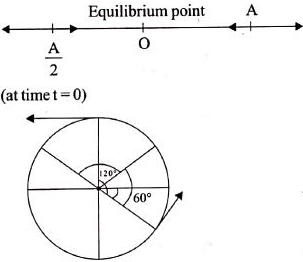
Two particles are performing simple harmonic motion in a straight line about the same equilibrium point. The amplitude and time period for both particles are same and equal to $A$ and $T,$ respectively. At time $t=0$ one particle has displacement $A$ while the other one has displacement $\frac {-A}{2}$ and they are moving towards each other. If they cross each other at time $t,$ then $t$ is
JEE MAIN 2016, Diffcult
Download our app for free and get started
Angle covered to meet $\theta=60^{\circ}=\frac{\pi}{3} \mathrm{rad}$
Experience the future of education. Simply download our apps or reach out to us for more information. Let's shape the future of learning together!No signup needed.*
In the reported figure, two bodies $A$ and $B$ of masses $200\, {g}$ and $800\, {g}$ are attached with the system of springs. Springs are kept in a stretched position with some extension when the system is released. The horizontal surface is assumed to be frictionless. The angular frequency will be $.....\,{rad} / {s}$ when ${k}=20 \,{N} / {m} .$
A particle executes $SHM$ with amplitude of $20 \,cm$ and time period is $12\, sec$. What is the minimum time required for it to move between two points $10\, cm$ on either side of the mean position ..... $\sec$ ?
The time period of a second's pendulum is $2\, sec$. The spherical bob which is empty from inside has a mass of $50\, gm$. This is now replaced by another solid bob of same radius but having different mass of $ 100\, gm$. The new time period will be .... $\sec$
For a particle executing simple harmonic motion, the kinetic energy $K$ is given by $K = {K_o}{\cos ^2}\omega t$. The maximum value of potential energy is
A particle executes simple harmonic motion with an amplitude of $5\, cm$. When the particle is at $4\, cm$ from the mean position, the magnitude of its velocity is $SI\,units$ is equal to that of its acceleration. Then, its periodic time in seconds is
Which of the following expressions corresponds to simple harmonic motion along a straight line, where $x$ is the displacement and $a, b, c$ are positive constants?
$Assertion :$ The time-period of pendulum, on a satellite orbiting the earth is infinity.
$Reason :$ Time-period of a pendulum is inversely proportional to $\sqrt g$
Find maximum amplitude for safe $SHM$ (block does not topple during $SHM$) of $a$ cubical block of side $'a'$ on a smooth horizontal floor as shown in figure (spring is massless)