Which of the following expressions corresponds to simple harmonic motion along a straight line, where $x$ is the displacement and $a, b, c$ are positive constants?
Easy
Download our app for free and get started
(d)
In linear $S.H.M.$, the restoring force acting on particle should always be proportional to the displacement of the particle and directed towards the equilibrium position.
i.e., $F \propto x$
or $F =- bx$ where $b$ is a positive constant.

Download our appand get started for free
Experience the future of education. Simply download our apps or reach out to us for more information. Let's shape the future of learning together!No signup needed.*
Similar Questions
- 1The springs in figure. $A$ and $B$ are identical but length in $A$ is three times that in $B$. The ratio of period $T_A/T_B$ isView Solution
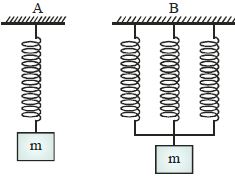
- 2particle moves with simple harmonic motion in a straight line. In first $\tau\ s$, after starting from rest it travels a distance $a$, and in next $\tau\ s$ it travels $2a$, in same direction, thenView Solution
- 3The time period of a simple pendulum of length $L$ as measured in an elevator descending with acceleration $\frac{g}{3}$ isView Solution
- 4The displacement of an object attached to a spring and executing simple harmonic motion is given by $ x= 2 \times 10^{-9}$ $ cos$ $\;\pi t\left( m \right)$ .The time at which the maximum speed first occurs isView Solution
- 5The velocity-time diagram of a harmonic oscillator is shown in the adjoining figure. The frequency of oscillation is ..... $Hz$View Solution
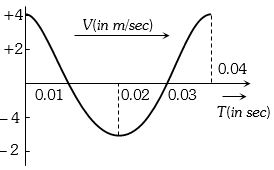
- 6In a simple pendulum, the period of oscillation $T$ is related to length of the pendulum $l$ asView Solution
- 7Two parallel discs are connected by a rigid rod of length $L=0.5 \,m$ centrally. Each disc has a slit oppositely placed as shown in the figure. A beam of neutral atoms are incident on one of the discs axially at different velocities $v$, while the system is rotated at angular speed of $600 \,rev / second$, so that atoms only with a specific velocity emerge at the other end. Calculate the two largest speeds (in metre/second) of the atoms that will emerge at the other end.View Solution
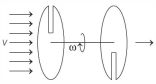
- 8A $2\, Kg$ block moving with $10\, m/s$ strikes a spring of constant $\pi ^2 N/m$ attached to $2\, Kg$ block at rest kept on a smooth floor, the velocity of the rear $2\, kg$ block after it separates from the spring will be ..... $m/s$View Solution
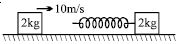
- 9The metallic bob of a simple pendulum has the relative density $\rho$. The time period of this pendulum is $T$. If the metallic bob is immersed in water, then the new time period is given byView Solution
- 10View SolutionTwo particles are oscillating along two close parallel straight lines side by side, with the same frequency and amplitudes. They pass each other, moving in opposite directions when their displacement is half of the amplitude. The mean positions of the two particles lie on a straight line perpendicular to the paths of the two particles. The phase difference is