MCQ
Two particles are simultaneously projected in opposite directions horizontally from a given point in space, where gravity $g$ is uniform. If $u_1$ and $u_2$ be their initial speeds, then the time $t$ after which their velocities are mutually perpendicular is given by
  • $\frac{\sqrt{u_1 u_2}}{g}$
  • B
    $\frac{\sqrt{u_1^2+u_2^2}}{g}$
  • C
    $\frac{\sqrt{u_1\left(u_1+u_2\right)}}{g}$
  • D
    $\frac{\sqrt{u_2\left(u_1+u_2\right)}}{g}$

Answer

Correct option: A.
$\frac{\sqrt{u_1 u_2}}{g}$
a
(a)

$v _1 \perp v _2$

$\therefore \quad v _1 \cdot v _2=0$

$\text { or }\left(u_1 \hat{ i }-g t \hat{ j }\right) \cdot\left(-u_2 \hat{ i }-g t \hat{ j }\right)=0$

$\therefore \quad g^2 t^2=u_1 u_2$

$\text { or }$

$t=\frac{\sqrt{u_1 u_2}}{g}$

Need a full question paper?

Generate a complete, print-ready paper with questions like this in minutes — across 16+ boards, with answer keys.

Start Generating Free

Similar questions

A person standing on an open ground hears the sound of a jet aeroplane, coming from north at an angle $60^o$ with ground level. But he finds the aeroplane right vertically above his position. If $\upsilon $ is the speed of sound, speed of the plane is
At what temperature the kinetic energy of gas molecule is half of the value at 27°C?
For a gas with one degree of freedom the adiabatic yield is $\gamma=\frac{ C _{ p }}{ C _{ v }}$
The velocity of the molecules of a gas at temperature $120\,K$ is $v$. At ...... $K$ temperature will the velocity be $2v$
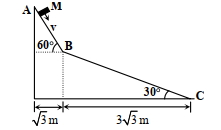
A small block of mass $M$ moves on a frictionless surface of an inclined plane, as shown in figure. The angle of the incline suddenly changes from $60^{\circ}$ to $30^{\circ}$ at point $\mathrm{B}$. The block is initially at rest at $A$. Assume that collisions between the block and the incline are totally inelastic $\left(\mathrm{g}=10 \mathrm{~m} / \mathrm{s}^2\right)$.

Figure: $Image$

$1.$ The speed of the block at point $B$ immediately after it strikes the second incline is

$(A)$ $\sqrt{60} \mathrm{~m} / \mathrm{s}$ $(B)$ $\sqrt{45} \mathrm{~m} / \mathrm{s}$

$(C)$ $\sqrt{30} \mathrm{~m} / \mathrm{s}$ $(D)$ $\sqrt{15} \mathrm{~m} / \mathrm{s}$

$2.$ The speed of the block at point $\mathrm{C}$, immediately before it leaves the second incline is

$(A)$ $\sqrt{120} \mathrm{~m} / \mathrm{s}$ $(B)$ $\sqrt{105} \mathrm{~m} / \mathrm{s}$

$(C)$ $\sqrt{90} \mathrm{~m} / \mathrm{s}$ $(D)$ $\sqrt{75} \mathrm{~m} / \mathrm{s}$

$3.$ If collision between the block and the incline is completely elastic, then the vertical (upward) component of the velocity of the block at point $B$, immediately after it strikes the second incline is

$(A)$ $\sqrt{30} \mathrm{~m} / \mathrm{s}$ $(B)$ $\sqrt{15} \mathrm{~m} / \mathrm{s}$

$(C)$ 0 $(D)$ $-\sqrt{15} \mathrm{~m} / \mathrm{s}$

Give the answer question $1,2$ and $3.$
A black body is heated from ${27^o}C$ to ${127^o}C$. The ratio of their energies of radiations emitted will be
Consider $a$ one-dimensional collision that involves $a$ body of mass $m_1$ originally moving in the positive $x$ direction with speed $v_0$ colliding with a second body of mass $m_2$ originally at rest. The collision could be completely inelastic, with the two bodies sticking together, completely elastic, or somewhere in between. After the collision, $m_1$ moves with velocity $v_1 $ while $m_2$ moves with velocity $v_2$.

$(A)$ $If \,m_1 > m_2$,

$(B)$ $If\, m_1 < m_2$,

A rod of legth l rotates with a uniform angular velocity $\omega$ about its perpendicular bisector. A uniform magnetic field B exists parallel to the axis of rotation. The potential difference between the two ends of the rod is:

  1. $\text{zero}$

  2. $\frac{1}{2}\text{Bl}\omega^2$

  3. $\text{Bl}\omega ^2$

  4. $2\text{B}\text{l}\omega^2$ 

Two bodies having same mass $40\, kg$ are moving in opposite directions, one with a velocity of $10$$m/s$ and the other with $7\,m/s.$ If they collide and move as one body, the velocity of the combination is ........ $m/s$
A force of $5\, N$acts on a particle along a direction making an angle of $60^°$ with vertical. Its vertical component be.......$N$