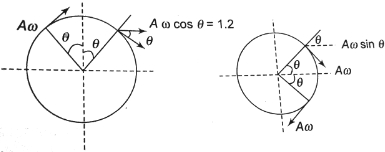
Two particles $P$ and $Q$ describe simple harmonic motions of same period, same amplitude, along the same line about the same equilibrium position $O.$ When $P$ and $Q$ are on opposite sides of $O$ at the same distance from $O$ they have the same speed of $1.2 \,m/s$ in the same direction, when their displacements are the same they have the same speed of $1.6\, m/s$ in opposite directions. The maximum velocity in $m/s$ of either particle is
Advanced
Download our app for free and get started

Download our appand get started for free
Experience the future of education. Simply download our apps or reach out to us for more information. Let's shape the future of learning together!No signup needed.*
Similar Questions
- 1The time period of a simple pendulum of length $L$ as measured in an elevator descending with acceleration $\frac{g}{3}$ isView Solution
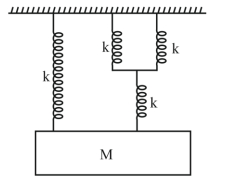
- 2The time period of simple harmonic motion of mass $\mathrm{M}$ in the given figure is $\pi \sqrt{\frac{\alpha M}{5 K}}$, where the value of $\alpha$ is____.View Solution
- 3A particle executes simple harmonic motion represented by displacement function as $x(t)=A \sin (\omega t+\phi)$View Solution
If the position and velocity of the particle at $t=0\, {s}$ are $2\, {cm}$ and $2\, \omega \,{cm} \,{s}^{-1}$ respectively, then its amplitude is $x \sqrt{2} \,{cm}$ where the value of $x$ is ..... .
- 4A ball suspended by a thread swings in a vertical plane so that its magnitude of acceleration in the extreme position and lowest position are equal. The angle $(\theta)$ of thread deflection in the extreme position will be :View Solution
- 5A plank with a small block on top of it is under going vertical $SHM$ . Its period is $2\ sec$ . The minimum amplitude at which the block will separate from plank isView Solution
- 6A pendulum has time period $T$ in air. When it is made to oscillate in water, it acquired a time period $T' = \sqrt 2 T$. The density of the pendulum bob is equal to (density of water $= 1$)View Solution
- 7Amplitude of a wave is represented by $A = \frac{c}{{a + b - c}}$ Then resonance will occur whenView Solution
- 8The total energy of the body executing $S.H.M.$ is $E$. Then the kinetic energy when the displacement is half of the amplitude, isView Solution
- 9A particle executes linear simple harmonic motion with an amplitude of $2\, cm$. When the particle is at $1\, cm$ from the mean position the magnitude of its velocity is equal to that of its acceleration. Then its time period in seconds isView Solution
- 10$Assertion :$ The amplitude of an oscillating pendulum decreases gradually with timeView Solution
$Reason :$ The frequency of the pendulum decreases with time.