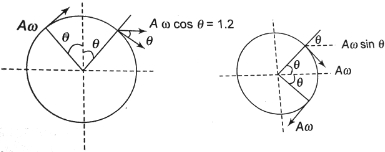
Two particles $P$ and $Q$ describe simple harmonic motions of same period, same amplitude, along the same line about the same equilibrium position $O.$ When $P$ and $Q$ are on opposite sides of $O$ at the same distance from $O$ they have the same speed of $1.2 \,m/s$ in the same direction, when their displacements are the same they have the same speed of $1.6\, m/s$ in opposite directions. The maximum velocity in $m/s$ of either particle is
Advanced


Download our appand get started for free
Experience the future of education. Simply download our apps or reach out to us for more information. Let's shape the future of learning together!No signup needed.*
Similar Questions
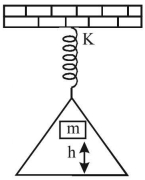
- 1A load of mass $m$ falls from a height $h$ on to the scale pan hung from the spring as shown in the figure. If the spring constant is $k$ and mass of the scale pan is zero and the mass $m$ does not bounce relative to the pan, then the amplitude of vibration isView Solution
- 2A pendulum suspended from the ceiling of a train oscillates with a time period $2$ $second$ , when the train is accelerating at $10\,ms^{-2}$. What will be its time period when the train retards at $10\,ms^{-2}$ ? .... $s$View Solution
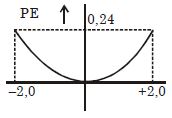
- 3A particle executing $S.H.M.$ its potential energy $V/S$ displacement graph is given by The value of restoring force constant is ..... $N/m$View Solution
- 4A particle of mass $m$ executes simple harmonic motion with amplitude $a$ and frequency $v$. The average kinetic energy during its motion from the position of equilibrium to the end isView Solution
- 5$2$ particles $p$ and $q$ describe $SHM$ of same amplitude $a$ and same frequency $f$ along straight line, the maximum distance between the two particle $a\sqrt 2 $ . The initial phase difference between particle isView Solution
- 6A simple pendulum executing $S.H.M.$ is falling freely along with the support. ThenView Solution
- 7Two particles are executing simple harmonic motion of the same amplitude $A$ and frequency $\omega $ along the $x-$ axis. Their mean position is separated by distance $X_0 (X_0> A)$. If the maximum separation between them is $(X_0 +A)$, the phase difference between their motion isView Solution
- 8A particle executes $SHM $ in a line $4\, cm $ long. Its velocity when passing through the centre of line is $12\, cm/s$. The period will be ..... $s$View Solution
- 9The height of a swing changes during its motion from $0.1\, m$ to $2.5\, m$. The minimum velocity of a boy who swings in this swing is ..... $m/s$View Solution
- 10A particle executes $SHM$ of amplitude $25\, cm$ and time period $3\, s$. What is the minimum time required for the particle to move between two points $12.5\, cm$ on either side of the mean position ..... $\sec$View Solution