MCQ
Two particles $P$ and $Q$ simultaneously start moving from point $A$ with velocities $15\,m / s$ and $20\,m / s$ respectively. The two particles move with accelerations equal in magnitude but opposite in direction. When $P$ overtakes $Q$ at $B$, then its velocity is $30\,m / s$. The velocity of $Q$ at point $B$ will be $..........\,m/s$
  • A
    $30$
  • $5$
  • C
    $20$
  • D
    $15$

Answer

Correct option: B.
$5$
b
(b)

For $P, 30=15+a t$

or $\quad a t=15\,m / s$

For $Q, v=20- at$

$v=20-15=5\,m / s$

Need a full question paper?

Generate a complete, print-ready paper with questions like this in minutes — across 16+ boards, with answer keys.

Start Generating Free

Similar questions

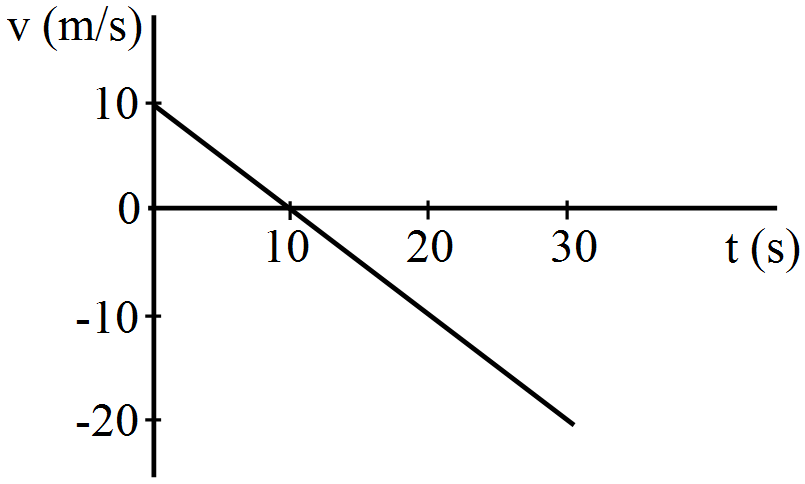
The velocity-time plot for a particle moving on a straight line is shown in the figure:

  1. The particle has a constant acceleration.
  2. The particle has never turned around.
  3. The particle has zero displacement.
  4. The average speed in the interval 0 to 10s is the same as the average speed in the interval 10s to 20s.
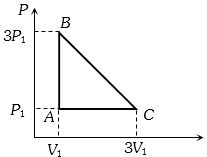
An ideal gas is taken around the cycle $ABCA$ as shown in the $P-V $ diagram. The net work done by the gas during the cycle is equal to
A particle moving along the $X-$axis executes simple harmonic motion, then the force acting on it is given by

Where $A$ and $K$ are positive constants

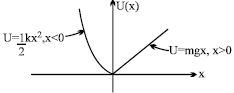
A particle of mass $m$ moves in the potential energy $U$ shown above. The period of the motion when the particle has total energy $E$ is
A hollow iron ball (A) and a solid iron ball (B) and cricket ball (C) are dropped from the same height. Which among the three balls reaches the ground first? Assuming there is no resistance due to air.
For the one-dimensional motion, described by $\text{x}=\text{t}-\sin\text{t}.$
A gas mixture consists of $3$ moles of oxygen and $5$ moles of argon at temperature $T$. Assuming the gases to be ideal and the oxygen bond to be rigid, the total internal energy (in units of $RT$ ) of the mixture is
Which of the following statements is incorrect?
A mass $M$ is suspended from a spring of negligible mass. The spring is pulled a little and then released so that the mass executes $S.H.M.$ of time period $T$. If the mass is increased by m, the time period becomes $5T/3$. Then the ratio of $m/M$ is
A person can jump higher on the lunar surface than on the earth's surface because: