MCQ
Two particles start simultaneously from the same point and move along two straight lines, one with uniform velocity $v$ and other with a uniform acceleration $a.$ If $\alpha$ is the angle between the lines of motion of two particles then the least value of relative velocity will be at time given by
  • A
    $(v/a)\,\, sin \,\,\alpha$
  • $(v/a)\,\, cos \,\,\alpha$
  • C
    $(v/a)\,\, tan \,\,\alpha$
  • D
    $(v/a)\,\,cot \,\,\alpha$

Answer

Correct option: B.
$(v/a)\,\, cos \,\,\alpha$
b
$\nu_{r}$ is subtraction of vectors. Hence,

$\nu_{r}^{2}=x(\operatorname{say})=\nu^{2}+(a t)^{2}-2 v(a t) \cos \alpha$

Now, $\nu_{r}$ will be minimum when $x$ is minimum

Hence $\frac{d x}{d t}=0$ or $2 a^{2} t-2 \nu a \cos \alpha=0$

$\mathrm{t}=\frac{\nu \cos \alpha}{a}$

Need a full question paper?

Generate a complete, print-ready paper with questions like this in minutes — across 16+ boards, with answer keys.

Start Generating Free

Similar questions

The amplitude of a particle executing $SHM$ is made three-fourth keeping its time period constant. Its total energy will be
$Assertion$ : In an elastic collision of two billiard balls, the total kinetic energy is conserved during the short time of oscillation of the balls (i.e., when they are in contact).
$Reason$ : Energy spent against friction does not follow the law of conservation of energy.
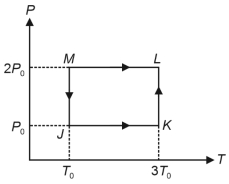
One mole of a monatomic ideal gas undergoes the cyclic process $J \rightarrow K \rightarrow L \rightarrow M \rightarrow J$, as shown in the $P - T$ diagram.

Match the quantities mentioned in $List-I$ with their values in $List-II$ and choose the correct option. [ $R$ is the gas constant]

$List-I$ $List-II$
($P$) Work done in the complete cyclic process ($1$) $R T_0-4 \ R T_0 \ln 2$
($Q$) Change in the internal energy of the gas in the process $JK$ ($2$) $0$
($R$) Heat given to the gas in the process $KL$ ($3$) $3 \ R T_0$
($S$) Change in the internal energy of the gas in the process $MJ$ ($4$) $-2 \ R T_0 \ln 2$
  ($5$) $-3 \ R T_0 \ln 2$

A particle moves in a circular path of radius $r$ with speed $v.$ It then increases its speed to $2\,v$ while travelling along the same circular path. The centripetal acceleration of the particle has changed by a factor of
A girl standing on road holds her umbrella at $45^{\circ}$ with the vertical to keep the rain away. If she starts running without umbrella with a speed of $15 \sqrt{2} \; kmh ^{-1}$, the rain drops hit her head vertically. The speed of rain drops with respect to the moving girl is ...........  $kmh ^{-1}$
A ball hits a vertical wall horizontally at $10m/s$  bounces back at $10 m/s$ 
A hydraulic automobile lift is designed to lift cars with a maximum mass of $3000\, kg$. The area of cross section a of piston carrying the load is $425\, cm ^{2}$. What is the maximum pressure () would smaller piston have to bear ?
The force of interaction between two atoms is given by $F\, = \,\alpha \beta \,\exp \,\left( { - \frac{{{x^2}}}{{\alpha kt}}} \right);$ where $x$ is the distance, $k$ is the Boltzmann constant and $T$ is temperature and $\alpha $ and $\beta $ are two constants. The dimension of $\beta $ is
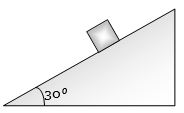
The time taken by a block of wood (initially at rest) to slide down a smooth inclined plane $9.8\, m$ long (angle of inclination is ${30^o}$) is.........$sec$
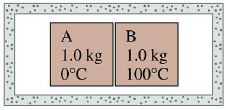
Objects $A$ and $B$ that are initially separated from each other and well isolated from their surroundings are then brought into thermal contact. Initially $T_A= 0^oC$ and $T_B = 100^oC$. The specific heat of $A$ is less than the specific heat of $B$. After some time, the system comes to an equilibrium state. The final temperatures are :