- A$\Big(\frac{\text{R}_1}{\text{R}_2}\Big)^{\frac{1}{2}}$
- B$\frac{\text{R}_1}{\text{R}_2}$
- ✓$\Big(\frac{\text{R}_1}{\text{R}_2}\Big)^2$
- D$\text{R}_1\text{R}_2.$
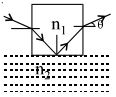
Particles $X$ and $Y$ of respective masses $m_1$ and $m_2$ are carrying charge q describing circular paths with respective radii $R_1$ and $R_2$ such that,
$\text{R}_1=\frac{\text{m}_1\text{v}_1}{\text{qB}}$
$\text{R}_1=\frac{\text{m}_2\text{v}_2}{\text{qB}}$
Since both the particles are accelerated through the same potential difference, both will have the same kinetic energy.
$\therefore\frac{1}{2}\text{m}_1\text{v}_1^2=\frac{1}{2}\text{m}_2\text{v}_2^2$
$\because\text{R}_1=\frac{\text{m}_1\text{v}_1}{\text{qB}}\Rightarrow\text{v}_1=\frac{\text{R}_1\text{qB}}{\text{m}_1}$
And,
$\text{R}_2=\frac{\text{m}_2\text{v}_2}{\text{qB}}\Rightarrow\text{v}_2=\frac{\text{R}_2\text{qB}}{\text{m}_2}$
$\therefore\text{m}_1\Big(\frac{\text{R}_1\text{qB}}{\text{m}_1}\Big)^2=\text{m}_2\Big(\frac{\text{R}_2\text{qB}}{\text{m}_2}\Big)^2$
$\Rightarrow\frac{\text{m}_1}{\text{m}_2}=\frac{\text{R}_1^2}{\text{R}_2^2}=\Big(\frac{\text{R}_1}{\text{R}_2}\Big)^2$
Generate a complete, print-ready paper with questions like this in minutes — across 16+ boards, with answer keys.