MCQ
Two particles $X$ and $Y$ having equal charges, after being accelerated through the same potential difference, enter a region of uniform magnetic field and describe circular paths of radii $R_1$ and $R_2$ respectively. The ratio of masses of $X$ to that of $Y$ is:
  • A
    $\Big(\frac{\text{R}_1}{\text{R}_2}\Big)^{\frac{1}{2}}$
  • B
    $\Big(\frac{\text{R}_2}{\text{R}_1}\Big)$
  • $\Big(\frac{\text{R}_1}{\text{R}_2}\Big)^2$
  • D
    $\Big(\frac{\text{R}_1}{\text{R}_2}\Big)$
Answer

Correct option: C.
$\Big(\frac{\text{R}_1}{\text{R}_2}\Big)^2$

Need a full question paper?

Generate a complete, print-ready paper with questions like this in minutes — across 16+ boards, with answer keys.

Start Generating Free

Similar questions

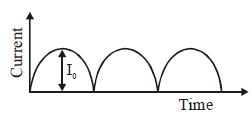
The output sinusoidal current versus time curve of a rectifier is shown in the figure. The average value of output current in this case is
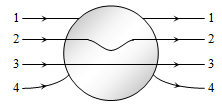
A metallic solid sphere is placed in a uniform electric field. The lines of force follow the path(s) shown in figure as
The nucleus $_{92}{U^{234}}$ splits exactly in half in a fission reaction in which two neutrons are released. The resultant nuclei are
Mosley's law relates the frequencies of line $X-$ rayswith the following characteristics of the target element
The sun radiates energy in all directions. The average radiations received on the earth surface from the sun is $1.4\;kilowatt/{m^2}$.The average earth- sun distance is $1.5 \times {10^{11}}metres$. The mass lost by the sun per day is($1$ day $= 86400$ seconds)
Some nuclei of a radioactive material are undergoing radioactive decay. The time gap between the instances when a quarter of the nuclei have decayed and when half of the nuclei have decayed is given as:

(where $\lambda$ is the decay constant)

Among the two interfering monochromatic sources A and B; A is ahead of B in phase by 66°. If the observation be taken from point P, such that PB – PA = l/4. Then the phase difference between the waves from A and B reaching P is
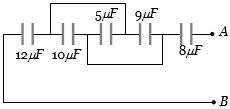
The capacities and connection of five capacitors are shown in the adjoining figure. The potential difference between the points $A$ and $B$ is $60\;volts$. Then the equivalent capacity between $A$ and $B$ and the charge on $5\,\mu F$ capacitance will be respectively
A bright star is indicated to have a brightness magnitude of – 5 compared to a star of brightness zero magnitude. It means that this star compared to the reference star of zero brightness is
The binding energy per nucleon of ${ }_5 B ^{10}$ is $8.0 \,MeV$ and that of ${ }_5 B ^{11}$ is $7.5 \,MeV$. The energy required to remove a neutron from ${ }_5 B ^{11}$ is .......... $MeV$ (take, mass of electron and proton are $9.11 \times 10^{-31} \,kg$ and $1.67 \times 10^{-27} \,kg$, respectively)