Question
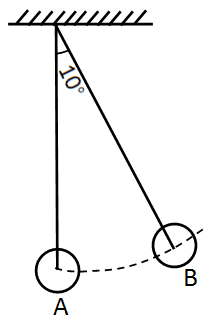
Two pendulums with identical bobs and lengths are suspended from a common support such that in rest position the two bobs are in contact. One of the bobs is released after being displaced by 10° so that it collides elastically head-on with the other bob.

  1. Describe the motion of two bobs.
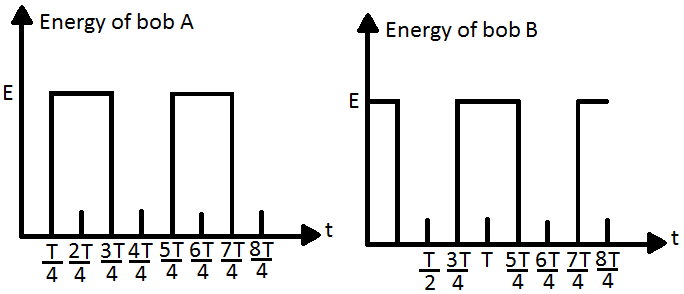
  2. Draw a graph showing variation in energy of either pendulum with time, for  where T is the period of each pendulum.

Answer

  1. Let at t = 0 A is at lowest position and B is at its height position at 10°

PEA = 0, PEB = E, KEA = KEB = 0

K.E. of both are zero. Now bob is released.

 reaches to A and collide elastically as both bobs are identical then,

KEA = 0, KEB = E, PEA = 0

PEB = 0

AT  reaches at it’s maximum height and B remains at it’s lowest position.

KEA = 0, KEB = E, PEA = E, PEB = 0

At  Bob A hits the bob B which was at rest elastically and ball A becomes at rest, B moves upward.

KEA = 0, KEB = E, PEA = E, PEB = 0

EA = 0, EB = E

At  Bob B is at its maximum height and A is at lower height.

So, KEA = 0, KEB = 0, PEA = 0, PEB = E

  1. The entire process is repeated.
Time t KEA PEA EA KEB PEB EB
0 0 0 0 0 E E
0 0 E 0 0 0
0 0 0 0 E E
E 0 E 0 0 0
0 0 0 0 E E

Need a full question paper?

Generate a complete, print-ready paper with questions like this in minutes — across 16+ boards, with answer keys.

Start Generating Free

Similar questions

In an experiment on the specific heat of a metal, a 0.20kg block of the metal at 150°C is dropped in a copper calorimeter (of water equivalent 0.025kg) containing 150cm3 of water at 27°C. The final temperature is 40°C. Compute the specific heat of the metal. If heat losses to the surroundings are not negligible, is your answer greater or smaller than the actual value for specific heat of the metal?
A 14.5kg mass, fastened to the end of a steel wire of unstretched length 1.0m, is whirled in a vertical circle with an angular velocity of 2rev/s at the bottom of the circle. The cross-sectional area of the wire is 0.065cm2. Calculate the elongation of the wire when the mass is at the lowest point of its path.
A particle P starts its motion at t = 0 and moves along a circle as shown in figure with period of 4s. Write down the equation representing S.H.M. of the particle P.
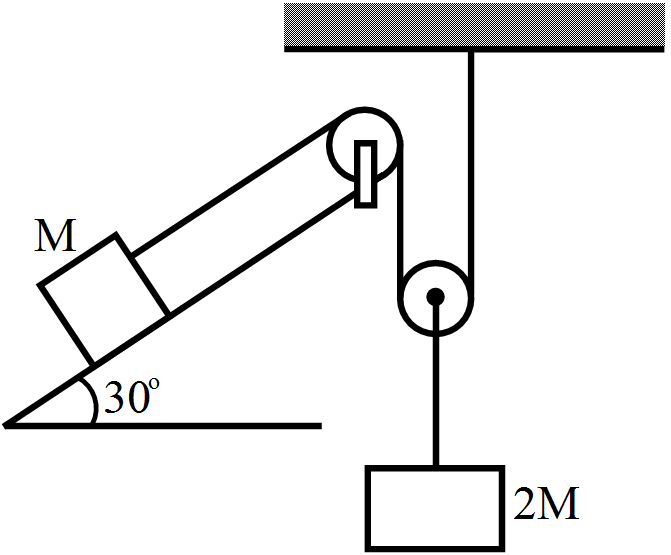
Find the acceleration of the block of mass M in the situation shown in figure. All the surfaces are frictionless and the pulleys and the string are light.

An air bubble of volume 1.0cm3 rises from the bottom of a lake 40m deep at a temperature of 12°C. To what volume does it grow when it reaches the surface, which is at a temperature of 35°C?
If the linear momentum is increased by 50%, what is the change in its kinetic energy?
A slightly tapering wire of length I and end radii a and b on both sides is subjected to the stretching forces F on both sides as shown in figure. If Y is the Young's modulus of the wire, calculate the extension produced in the wire.
A $100\mu\text{F}$ capacitor is joined to a 24V battery through a $1.0\text{M}\Omega$ resistor. Plot qualitative graphs (a) between current and time for the first 10 minutes and (b) between charge and time for the same period.
The transverse displacement of a string (clamped at its both ends) is given by
$\text{y}(\text{x, t})=0.06\sin\Big(\frac{2\pi}{3}\text{x}\Big)\cos(120\pi\text{ t})$
where x and y are in m and t in s. The length of the string is 1.5m and its mass is 3.0 × 10–2kg.
Answer the following:
Determine the tension in the string.
A uniform disc of radius R is put over another uniform disc of radius 2R of the same thickness and density. The peripheries of the two discs touch each other. Locate the centre of mass of the system.