Question
A $100\mu\text{F}$ capacitor is joined to a 24V battery through a $1.0\text{M}\Omega$ resistor. Plot qualitative graphs (a) between current and time for the first 10 minutes and (b) between charge and time for the same period.

Answer

Time constant $\text{RC} = 1 \times 10^6 \times 100 \times 10^6 = 100 \text{sec}$

  1. $\text{q}=\text{VC}\Big(1-\text{e}^{\frac{-\text{t}}{\text{CR}}}\Big)$

I = Current $=\frac{\text{dq}}{\text{dt}}=\text{VC}.(-)\text{e}^{\frac{-\text{t}}{\text{RC}}},\frac{-1}{\text{RC}}$

$=\frac{\text{V}}{\text{R}}\text{e}^{\frac{-\text{t}}{\text{RC}}}=\frac{\text{V}}{\text{R}\cdot\text{e}^{\frac{\text{t}}{\text{RC}}}}=\frac{24}{10^6}\times\frac{1}{\text{e}^{\frac{\text{t}}{100}}}$

$=24\times10^{-6}\frac{1}{\text{e}^{\frac{\text{t}}{100}}}$

$\text{t}=10\text{min},600\text{sec}.$

$\text{Q}=24\times10+-4\times\big(1-\text{e}^{-6}\big)=23.99\times10^{-4}$

$\text{I}=\frac{24}{10^6}\times\frac{1}{\text{e}^6}=5.9\times10^{-8}\text{Amp}.$

  1. $\text{q}=\text{VC}\Big(1-\text{e}^\frac{-\text{t}}{\text{CR}}\Big)$

Need a full question paper?

Generate a complete, print-ready paper with questions like this in minutes — across 16+ boards, with answer keys.
Start Generating Free

Similar questions

A rocket is fired ‘vertically’ from the surface of mars with a speed of 2km s-1. If 20% of its initial energy is lost due to martian atmospheric resistance, how far will the rocket go from the surface of mars before returning to it? Mass of mars = 6.4 × 10²³kg; radius of mars = 3395km; G = 6.67 × 10⁻¹¹N m2 kg-2.
Explain why.
There is no atmosphere on moon.
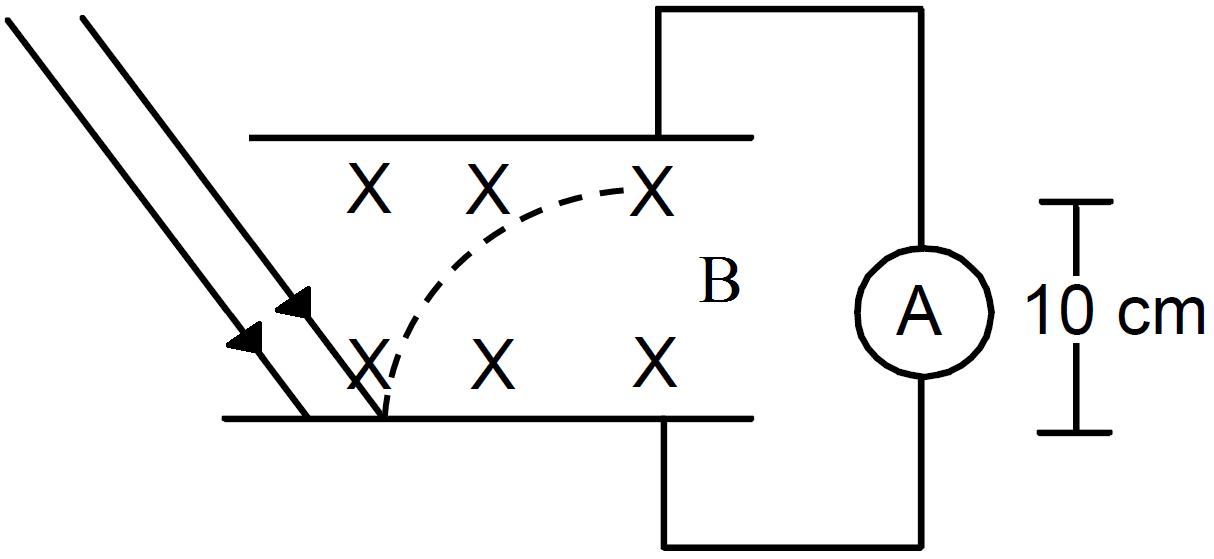
In an experiment on photoelectric effect, the emitter and the collector plates are placed et a separation of 10cm and are connected through en ammeter without any cell A magnetic field B exists parallel to the plates. The work function of the emitter is 2.39eV and the light incident on it has wavelengths between 400nm and 600nm. Find the minimum value of B for which the current registered by the ammeter is zero. Neglect any effect of space charge.

Define and explain the following:
(i) Weight
(ii) Action and reaction forces
(iii) Tension
(iv) Impulse
(v) Spring force.
A particle of mass m moving with an initial velocity u collides in elastically with a particle of mass M initially at rest. If the collision is completely inelastic, then find expressions for:
  1. Final velocity of combined entity and
  2. Loss in kinetic energy during collision.
During summers in India, one of the common practice to keep cool is to make ice balls of crushed ice, dip it in flavoured sugar syrup and sip it. For this a stick is inserted into crushed ice and is squeezed in the palm to make it into the ball. Equivalently in winter, in those areas where it snows, people make snow balls and throw around. Explain the formation of ball out of crushed ice or snow in the light of P–T diagram of water.
When slow neutrons are incident on a target containing  $\frac{235}{92}\text{U},$ a possible fission reaction is $\frac{235}{92}\text{U}+_0^1\text{n}\rightarrow\frac{141}{56}\text{Ba}+\frac{92}{36}\text{Kr}+3_0\text{n}^1$
Estimate the amount of energy released using following data :
$\text{M}\Big(\frac{235}{92}\text{U}\Big)=235.04\text{amu}$
$\Big(\text{M}\frac{92}{36}\text{Kr}\Big)=91.926\text{amu}$
$\text{M}\Big(\frac{141}{56}\text{Ba}\Big)=140.91\text{amu}$
$\text{M}=1.0087\text{ amu}$
Find the variation of acceleration due to gravity below the surface of earth at depth d.

OR

Write Kepler's laws for planetary motion.

Consider a one-dimensional motion of a particle with total energy E. There are four regions A, B, C and D in which the relation between potential energy V, kinetic energy (K) and total energy E is as given below:
Region A : V > E
Region B : V < E
Region C : K > E
Region D : V > K
State with reason in each case whether a particle can be found in the given region or not.
A gun is mounted on a railroad car. The mass of the car, the gun, the shells and the operator is 50m where m is the mass of one shell. If the velocity of the shell with respect to the gun (in its state before firing) is 200m/s, what is the recoil speed of the car after the second shot? Neglect friction.