MCQ
Two persons pull a wire towards themselves. Each person exerts a force of $200 \mathrm{~N}$ on the wire. Young's modulus of the material of wire is $1 \times 10^{11} \mathrm{~N} \mathrm{~m}^{-2}$. Original length of the wire is $2 \mathrm{~m}$ and the area of cross section is $2 \mathrm{~cm}^2$. The wire will extend in length by . . . . . . . .$\mu \mathrm{m}$.
  • A
    $17$
  • B
    $18$
  • $20$
  • D
    $21$

Answer

Correct option: C.
$20$
c
$\frac{\mathrm{F}}{\mathrm{A}}=\mathrm{Y} \frac{\Delta \ell}{\ell} \Rightarrow \Delta \ell=\frac{\mathrm{F} \ell}{\mathrm{AY}}$

$\Delta \ell=\frac{200 \times 2}{2 \times 10^{-4} \times 10^{11}}=2 \times 10^{-5}=20 \mu$

Need a full question paper?

Generate a complete, print-ready paper with questions like this in minutes — across 16+ boards, with answer keys.

Start Generating Free

Similar questions

A cricket ball of mass $500\, g$ collides with a bat with speed $15\, m/s$ and returns with the same speed within $0.01$ $second$ . The force acted on bat is ............ $ N$
Small droplets of a liquid are usually more spherical in shape than larger drops of the same liquid because
Any vector in an arbitrary direction can always be replaced by two (or three)
The mass and volume of a body are $4.237g$ and $2.5\ cm^3$, respectively. The density of the material of the body in correct significant figures is:
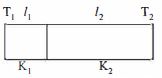
One end of a thermally insulated rod is kept at a temperature $T_1$ and the other at $T_2$ . The rod is composed of two sections of length $l_1$ and $l_2$ and thermal conductivities $K_1$ and $K_2$ respectively. The temperature at the interface of the two section is
A hosepipe directs a horizontal jet of water moving with velocity of $20\, m/s$ on a vertical wall. The cross-sectional area of jet is $10^{-3}\,m^2$. If density of water is $1000\, kg/m^3$, then force acting on wall is ........... $N$ [Assuming water comes to rest after striking wall]
If the current is doubled, the deflection is also doubled in:
A body oscillates with $S.H.M.$ according to the equation $x=(5.0 \,m ) \cos \left[\left(2 \pi \,rad s ^{-1}\right) t+\pi / 4\right]$ At $t=1.5 \,s$, its acceleration is ....... $m / s ^2$
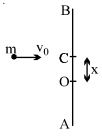
$A$ uniform rod $AB$ of length $L$ and mass $M$ is lying on a smooth table. $A$ small particle of mass $m$ strike the rod with a velocity $v_0$ at point $C$ at a distance $x$ from the centre $O$. The particle comes to rest after collision. The value of $x$, so that point $A$ of the rod remains ststionary just after collision is:
The initial velocity of a particle is $u$ (at $t = 0$) and the acceleration ${n^{th}}$ is given by $at$. Which of the following relation is valid