MCQ
Two photons having:
- AEqual wavelengths have equal linear momenta.
- BEqual energies have equal linear momenta.
- CEqual frequencies have equal linear momenta.
- DEqual linear momenta have equal wavelengths.
Explanation:
Two photons having equal linear momenta have equal wavelengths is correct. As in the rest of the options magnitude of momentum or energy can be same because energy and momentum are inversely proportional to wavelength. But the direction of propagation of the photons can be different.
Generate a complete, print-ready paper with questions like this in minutes — across 16+ boards, with answer keys.
The energy of a photon of characteristic X-rays from a Coolidge tube comes from
| (a) The kinetic energy of the striking electron |
| (b) The kinetic energy of the free electrons of the target |
| (c) The kinetic energy of the ions of the target |
| (d) An electronic transition of the target atom |
Optical fibres are related with
|
(a) Communication |
(b) Light |
(c) Computer |
(d) None of these |
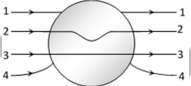
The image of an extended object, placed perpendicular to the principal axis of a mirror, will be erect if:
Two metal spheres of capacitance  and
and  carry some charges. They are put in contact and then separated. The final charges
  and
and  on them will satisfy
|
(a) |
(b) |
(c) |
(d) |
P-type semiconductor is formed when
A. As impurity is mixed in Si B. Al impurity is mixed in Si
C. B impurity is mixed in Ge D. P impurity is mixed in Ge
|
(a) A and C |
(b) A and D |
(c) B and C |
(d) B and D |


