MCQ
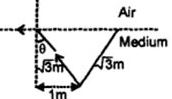
refractive index of medium is
  • A
    $2$
  • B
    $3$
  • C
    $\frac{1}{{2\sqrt 2 }}$
  • $\sqrt 3 $

Answer

Correct option: D.
$\sqrt 3 $
d
$\mu \,\, = \,\, \frac{1}{{sin\theta }}\,\, = \,\,\frac{1}{{1/\sqrt 3 }}\,\, = \,\,\sqrt 3 $

Need a full question paper?

Generate a complete, print-ready paper with questions like this in minutes — across 16+ boards, with answer keys.

Start Generating Free

Similar questions

What will be the angular width of central maxima in frunhofer diffraction when light of wavelength $6000\,\mathop A\limits^o $ is used and slit width is $12 \times 10^{-5}\,cm$ ?..........$ rad$
The surface of a metal is illuminated with light of $400\, nm$. The maximum kinetic energy of the ejected photoelectrons was found to be $1.68\, eV$. The work function of the metal is.......$eV$  $(hc = 1240\, eV\, nm)$
An inductance of $0.2 H$ and a resistance of $100\Omega$ are connected in series to an $A.C. 180 V, 50 Hz$ supply. The apparent current flowing in the circuit will be.
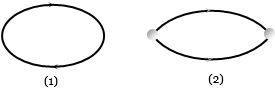
Below figures $(1)$ and $(2)$ represent lines of force. Which is correct statement
Three transparent media of refractive indices $\mu_1,\mu_2$ and $\mu_3.$ A point object $O$ is placed in the medium $\mu_2.$ If the entire medium on the right of the spherical surface has refractive index $\mu_1,$ the image forms at $O'$. If this entire medium has refractive index $\mu_3,$ the image forms at $O"$. In the situation shown:
C and Si both have the same lattice structure, having 4 bonding electrons in each. However, C is an insulator whereas Si is an intrinsic semiconductor. This is because
A. In case of C the valence band is not completely filled at absolute zero temperature.
B. In case of C the conduction band is partly filled even at absolute zero temperature.
C. The four bonding electrons in the case of C lie in the second orbit, whereas in the case of Si they lie in the third.
D. The four bonding electrons in the case of C lie in the third orbit, whereas for Si they lie in the fourth orbit.
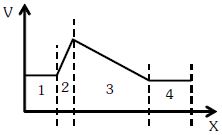
In which region magnitude of $x$ -component of electric field is maximum, if potential $(V)$ versus distance $(X)$, graph is as shown?
Suppose potential energy between electron and proton at separation r is given by $U = K$ ln $(r)$, where $K$ is a constant. For such a hypothetical hydrogen atom, the ratio of energy difference between energy levels $(n = 1$ and $n = 2)$ and $(n = 2$ and $n = 4)$ is?
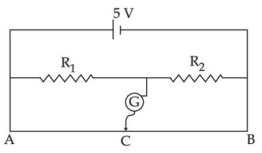
In the given figure of meter bridge experiment, the balancing length $AC$ corresponding to null deflection of the galvanometer is $40\,cm$. The balancing length, if the radius of the wire $AB$ is doubled, will be $....cm$
What should be the angle between two plane mirrors so that whatever be the angle of incidence, the incident ray and the reflected ray from the two mirrors be parallel to each other.....$^o$