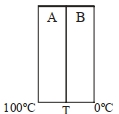
Two plates $A$ and $B$ have thermal conductivities $84\,Wm ^{-1}\,K ^{-1}$ and $126\,Wm ^{-1}\,K ^{-1}$ respectively. They have same surface area and same thickness. They are placed in contact along their surfaces. If the temperatures of the outer surfaces of $A$ and $B$ are kept at $100^{\circ}\,C$ and $0{ }^{\circ}\,C$ respectively, then the temperature of the surface of contact in steady state is $..........\,{ }^{\circ} C$.
JEE MAIN 2023, Medium


Download our appand get started for free
Experience the future of education. Simply download our apps or reach out to us for more information. Let's shape the future of learning together!No signup needed.*
Similar Questions
- 1One end of a metal rod of length $1.0 m$ and area of cross section $100c{m^2}$ is maintained at ${100^o}C.$If the other end of the rod is maintained at ${0^o}C$, the quantity of heat transmitted through the rod per minute is (Coefficient of thermal conductivity of material of rod =$100W/m-K$)View Solution
- 2Two bottles $A$ and $B$ have radii $R_{A}$ and $R_{B}$ and heights $h_{A}$ and $h_{B}$ respectively, with $R_{B}=2 R_{A}$ and $h_{B}=2 h_{A}$. These are filled with hot water at $60^{\circ} C$. Consider that heat loss for the bottles takes place only from side surfaces. If the time, the water takes to cool down to $50^{\circ} C$ is $t_{A}$ and $t_{B}$ for bottles $A$ and $B$, respectively. Then, $t_{A}$ and $t_{B}$ are best related asView Solution
- 3A cylindrical rod having temperature ${T_1}$ and ${T_2}$ at its ends. The rate of flow of heat is ${Q_1}$ $cal/sec$. If all the linear dimensions are doubled keeping temperature constant then rate of flow of heat ${Q_2}$ will beView Solution
- 4View SolutionMud houses are cooler in summer and warmer in winter because
- 5$A$ wall has two layers $A$ and $B$ made of different materials. The thickness of both the layers is the same. The thermal conductivity of $A$ and $B$ are $K_A$ and $K_B$ such that $K_A = 3K_B$. The temperature across the wall is $20°C$ . In thermal equilibriumView Solution
- 6A hot metallic sphere of radius $r$ radiates heat. It's rate of cooling isView Solution
- 7A rod of length $L$ with sides fully insulated is of a material whose thermal conductivity varies with $\alpha$ temperature as $ K= \frac{\alpha }{T}$, where $\alpha$ is a constant. The ends of the rod are kept at temperature $T_1$ and $T_2$. The temperature $T$ at $x,$ where $x$ is the distance from the end whose temperature is $T_1$ isView Solution
- 8A heat source at $T = 10^3\, K$ is connected to another heat reservoir at $T = 10^2\, K$ by a copper slab which is $1\, m$ thick. Given that the thermal conductivity of copper is $0.1\, WK^{-1}\, m^{-1}$, the energy flux through it in the steady state is ........... $Wm^{-2}$View Solution
- 9The following three objects $(1)$ a metal tray, $(2)$ a block of wood and $(3)$ a woolen cap are left in a closed room overnight. Next day, the temperature of each is recorded as $T_1, T_2$ and $T_3$, respectively. The likely situation isView Solution
- 10A human body has a surface area of approximately $1 \mathrm{~m}^2$. The normal body temperature is $10 \mathrm{~K}$ above the surrounding room temperature $T_0$. Take the room temperature to be $T_0=300 \mathrm{~K}$. For $T_0=300 \mathrm{~K}$, and the value of $\sigma \mathrm{T}_0^4=460 \mathrm{Wm}^{-2}$ (where $\sigma$ is the Stefan-Boltzmann constant). Which of the following option is/are correct?View Solution
[$A$] The amount of energy radiated by the body in $1$ second is close to $60$ Joules.
[$B$] If the surrounding temperature reduces by a small amount $\Delta \mathrm{T}_0<<\mathrm{T}_0$, then to maintain the same body temperature the same (living) human being needs to radiate $\Delta \mathrm{W}=4 \sigma \mathrm{T}_0^3 \Delta \mathrm{T}_0$ more energy per unit time.
[$C$] Reducing the exposed surface area of the body ($e.g$ by curling up) allows humans to maintain the same body temperature while reducing the energy lost by radiation.
[$D$] If the body temperature rises significantly then the peak in the spectrum of electromagnetic radiation emitted by the body would shift to longer wavelengths.