A cylindrical rod having temperature ${T_1}$ and ${T_2}$ at its ends. The rate of flow of heat is ${Q_1}$ $cal/sec$. If all the linear dimensions are doubled keeping temperature constant then rate of flow of heat ${Q_2}$ will be
AIPMT 2001, Medium
Download our app for free and get started
(b)Rate of heat flow $\left( {\frac{Q}{t}} \right) = \frac{{k\pi {r^2}({\theta _1} - {\theta _2})}}{L} \propto \frac{{{r^2}}}{L}$
$\therefore$ $\frac{{{Q_1}}}{{{Q_2}}} = {\left( {\frac{{{r_1}}}{{{r_2}}}} \right)^2}\left( {\frac{{{l_2}}}{{{l_1}}}} \right) = {\left( {\frac{1}{2}} \right)^2} \times \left( {\frac{2}{1}} \right) = \frac{1}{2}$
==> ${Q_2} = 2{Q_1}$

Download our appand get started for free
Experience the future of education. Simply download our apps or reach out to us for more information. Let's shape the future of learning together!No signup needed.*
Similar Questions
- 1The ratio of the diameters of two metallic rods of the same material is $2 : 1$ and their lengths are in the ratio $1 : 4$ . If the temperature difference between their ends are equal, the rate of flow of heat in them will be in the ratioView Solution
- 2Certain quantity of water cools from $70^o C$ to $60^o C$ in the first $5$ minutes and to $54^o C$ in the next $5$ minutes. The temperature of the surroundings is ..... $^oC$View Solution
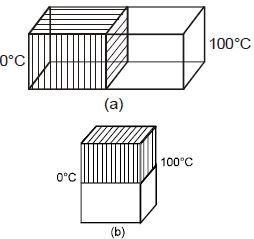
- 3Two identical square rods of metal are welded end to end as shown in figure $(a)$. Assume that $10\, cal$ of heat flows through the rods in $2\, min$. Now the rods are welded as shown in figure, $(b)$. The time it would take for $10$ cal to flow through the rods now, is ........ $\min$View Solution
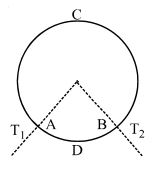
- 4Aring consisting of two parts $ADB$ and $ACB$ of same conductivity $k$ carries an amount of heat $H$. The $ADB$ part is now replaced with another metal keeping the temperatures $T_1$ and $T_2$ constant. The heat carried increases to $2H$. What $ACB$ should be the conductivity of the new$ADB$ part? Given $\frac{{ACB}}{{ADB}}= 3$View Solution
- 5A body takes $5$ minute to cool from $80°C$ to $50°C$ . ...... $\min.$ it will take to cool from $60°C$ to $30°C$ , if room temperature is $20°C$ .View Solution
- 6View SolutionA hot and a cold body are kept in vacuum separated from each other. Which of the following causes decrease in temperature of the hot body?
- 7Energy is being emitted from the surface of a black body at ${127^o}C$ temperature at the rate of $1.0 \times {10^6}J/\sec - {m^2}$. Temperature of the black body at which the rate of energy emission is $16.0 \times {10^6}J/\sec - {m^2}$ will be......... $^oC$View Solution
- 8A hot body, obeying Newton's law of cooling is cooling down from its peak value $80\,^oC$ to an ambient temperature of $30\,^oC$ . It takes $5\, minutes$ in cooling down from $80\,^oC$ to $40\,^oC$. ........ $\min.$ will it take to cool down from $62\,^oC$ to $32\,^oC$ ? (Given $ln\, 2\, = 0.693, ln\, 5\, = 1.609$)View Solution
- 9A body cools from a temperature $3T$ to $2T$ in $10$ minutes. The room temperature is $T.$ Assume that Newton's law of cooling is applicable. The temperature of the body at the end of next $10$ minutes will beView Solution
- 10Rate of cooling at $600K$ , if surrounding temperature is $300K$ is $R$ . The rate of cooling at $900K$ isView Solution