MCQ
Two point charges +9e and +e are at 16 cm away from each other. Where should another charge q be placed between them so that the system remains in equilibrium
  • A
     24 cm from +9e
  •  12 cm from +9e
  • C
     24 cm from +e
  • D
    12 cm from +e

Answer

Correct option: B.
 12 cm from +9e
12 cm from +9e

Need a full question paper?

Generate a complete, print-ready paper with questions like this in minutes — across 16+ boards, with answer keys.

Start Generating Free

Similar questions

In interchanging the corresponding positions of battery and galvanometer in a Wheatstone bridge, the balanced position:
Two coherent sources of light interfere. The intensity ratio of two sources is $1: 4$. For this interference pattern if the value of $\frac{I_{\max }+I_{\min }}{I_{\max _{\max }}-I_{\min }}$ is equal to $\frac{2 \alpha+1}{\beta+3}$, then $\frac{\alpha}{\beta}$ will be.
Assertion : Kirchoff 's junction rule follows from conservation of charge.

Reason : Kirchoff 's loop rule follows from conservation of momentum.

If a copper ring is moved quickly towards south pole of a powerful stationary bar magnet, then [
Match List $- I$ with List $- II:$

  List$-1$ (Electromagnetic waves)   List$-2$ (Wavelength)
$(a)$ $AM$ radio waves $(i)$ $10^{-10}\,m$
$(b)$ Microwaves $(ii)$ $10^{2}\,m$
$(c)$ Infrared radiations $(iii)$ $10^{-2}\,m$
$(d)$ $X-$rays $(iv)$ $10^{-4}\,m$

Choose the correct answer from the options given below:
If the screen is moved away from the plane of the slits in a Young's double slit experiment, then the
Which is not true with respect to the cathode rays
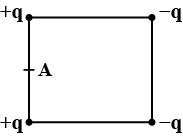
Four electric charges $+q,+q, -q$ and $-q$ are placed at the comers of a square of side $2L$ (see figure). The electric potential at point $A,$ midway between the two charges $+q$ and $+q,$ is
When $100\, V\, DC$ is applied across a solenoid a current of $1\, A$ flows in it. When $100\, V\, AC$ is applied across the same coil, the current drops to $0.5\, A$. If the frequency of the $AC$ source is $50\,Hz$, the impedance and inductance of the solenoid are:
A radioactive nucleus $A$ has a single decay mode with half-life $\tau_A$. Another radioactive nucleus $B$ has two decay modes $1$ and $2$. If decay mode $2$ were absent, the half-life of $B$ would have been $\tau_A / 2$. If decay mode $1$ were absent, the half-life of $B$ would have been $3 \tau_A$. If the actual half life of $B$ is $\tau_B$, then the ratio $\tau_B / \tau_A$ is