MCQ
Which is not true with respect to the cathode rays
  • A
    A stream of electrons
  • B
    Charged particles
  • Move with speed same as that of light
  • D
    Can be deflected by magnetic fields

Answer

Correct option: C.
Move with speed same as that of light

Need a full question paper?

Generate a complete, print-ready paper with questions like this in minutes — across 16+ boards, with answer keys.
Start Generating Free

Similar questions

The continuous $X-$ rays spectrum produced by an $X-$ ray machine at constant voltage has
The focal length of a convex lens is $10 cm$ and its refractive index is $1.5$. If the radius of curvature of one surface is $7.5 cm,$ the radius of curvature of the second surface will be......$cm$
The ratio of charge to potential of a body is known as
The forbidden energy gap in $Ge$ is $0.72\,eV.$ Given, $hc = 12400\,eV -\mathop A\limits^o $. The maximum wavelength of radiation the will generate electron electron hole pair is..........$\mathop A\limits^o $
A cylindrical conductor of radius $'R'$ carries a current $'i'$. The value of magnetic field at a point which is $R/4$ distance inside from the surface is $10\, T$. Find the value of magnetic field at point which is $4\,R$ distance outside from the surface
The conduction band and valency band of a good conductor are:
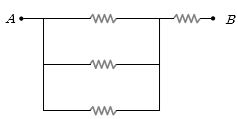
If all the resistors shown have the value $2\, ohm$ each, the equivalent resistance over $AB$ is
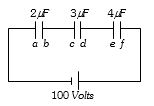
Three capacitors are connected to $D.C.$ source of $100\;volts$ shown in the adjoining figure. If the charge accumulated on plates of ${C_1},\;{C_2}$ and ${C_3}$ are ${q_a},\;{q_b},\;{q_c},{q_d}.{q_e}$ and ${q_f}$ respectively, then
$X$-rays of wavelength $22 \,pm$ are scattered from a carbon target at an angle of $85^{\circ}$ to the incident beam. The Compton shift for $X$-rays is ......... $pm$
A uniform electric field pointing in positive X-direction exists in a region. Let A be the origin, B be the point on the X-axis at x = +1 cm and C be the point on the Y-axis at y 1 cm. Then the potential at points A, B and C satisfy