MCQ
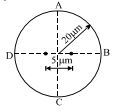
Two point source separated by $d = 5\, \mu m$ emit light of wavelength $\lambda = 2\, \mu m$ in phase.Acircular wire of radius $20\, \mu m$ is placed around the source as shown in figure.
  • A
    Point $A$ and $B$ are dark and points $C$ and $D$ are bright.
  • B
    Points $A$ and $B$ are bright and point $C$ and $D$ are dark.
  • C
    Points $A$ and $C$ are dark and points $B$ and $D$ are bright.
  • Points $A$ and $C$ are bright and points $B$ and $D$ are dark.
Answer

Correct option: D.
Points $A$ and $C$ are bright and points $B$ and $D$ are dark.
d

Need a full question paper?

Generate a complete, print-ready paper with questions like this in minutes — across 16+ boards, with answer keys.

Start Generating Free

Similar questions

An electric dipole is put in north-south direction in a sphere filled with water. Which statement is correct
The length of a magnet is large compared to it's width and breadth. The time period of its oscillation in a vibration magnetometer is $T$. The magnet is cut along it’s length into six parts and these parts are then placed together as shown in the figure. The time period of this combination will be
In oscillating LC circuit, the total stored energy is $U$ and maximum charge upon capacitor is $Q$. When the charge upon the capacitor is $\frac{Q}{2}$, the energy stored in the inductor is
The frequency and intensity of a light source are both doubled. Consider the following statements.
  1. The saturation photocurrent remains almost the same.
  2. The maximum kinetic energy of the photoelectrons is doubled.
Assertion : Owls can move freely during night.
Reason : They have large number of rods on their retina.
After absorbing a slowly moving neutron of mass $m _{ N }$ (momentum-$0$) a nucleus of mass $M$ breaks into two nuclei of masses $m _{1}$ and $5 m _{1}\left(6 m _{1}= M + m _{ N }\right)$ respectively. If the de-Broglie wavelength of the nucleus with mass $m_{1}$ is $\lambda$, then de-Broglie wavelength of the other nucleus will be
Diffusion current in a $p-n$ junction is greater than the drift current in magnitude:
In Young's double slit experiment, if the separation between coherent sources is halved and the distance of the screen from the coherent sources is doubled, then the fringe width becomes:
Let $A_n$ be the area enclosed by the $n^{th}$ orbit in a hydrogen atom. The graph of $\ln (A_n/A_1)$ agains $\ln (n).$
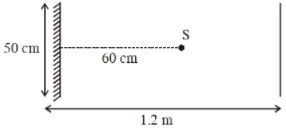
A point source of light $S$, placed at a distance $60 \,cm$ infront of the centre of a plane mirror of width $50 \,cm$, hangs vertically on a wall. A man walks infront of the mirror along a line parallel to the mirror at a distance $1.2\, m$ from it (see in the $figure$). The distance between the extreme points where he can see the image of the light source in the mirror is $\ldots \ldots \ldots\, cm.$