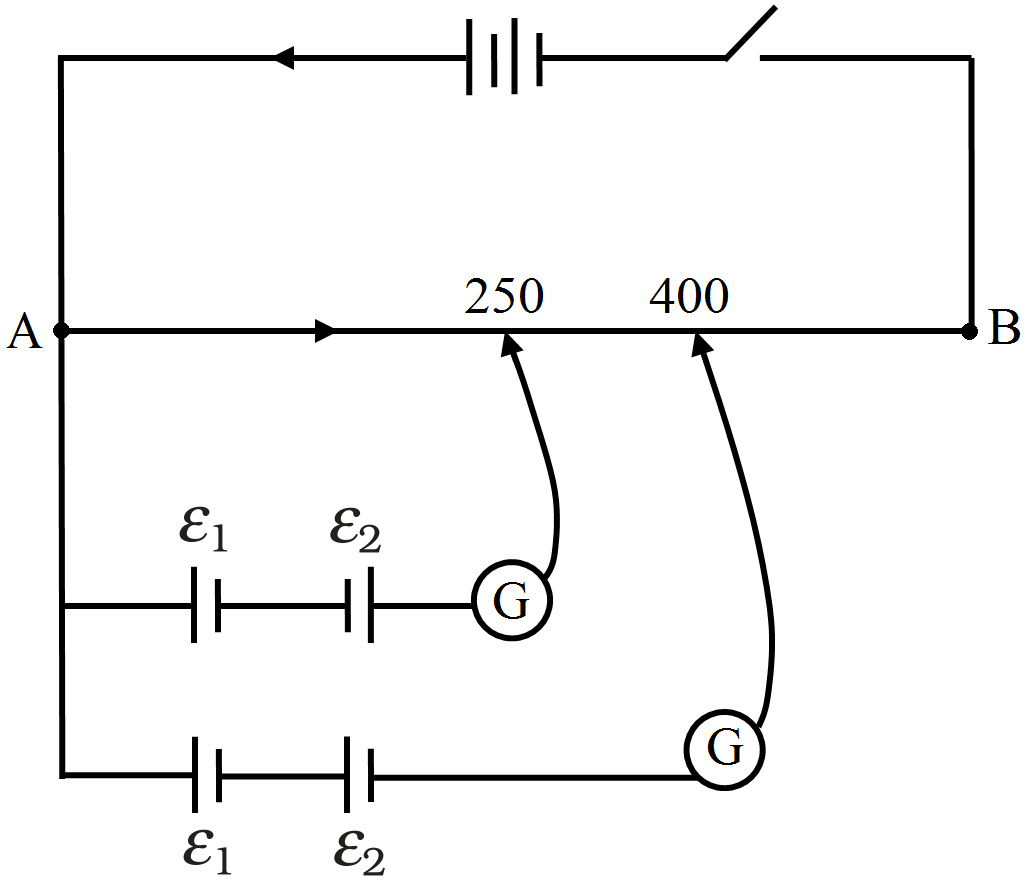
Two primary cells of emfs wire $\varepsilon_1$ and $\varepsilon_2(\varepsilon_1>\varepsilon_2)$ are connected to a potentiometer wire AB as shown in fig. If the balancing lengths for the two combinations of the cells are 250cm and 400cm, find the ratio of $\varepsilon_1$ and $\varepsilon_2.$
Download our app for free and get startedPlay store
In first combination $\varepsilon_1$ and $\varepsilon_2$ are opposing each other while in second combination $\varepsilon_1$ and $\varepsilon_2$ are adding each other,
So,
$\varepsilon_1-\varepsilon_2=\text{Kl}_1$
$\varepsilon_1+\varepsilon_2=\text{kl}_2$
$\frac{\varepsilon_1-\varepsilon_2}{\varepsilon_1+\varepsilon_2}=\frac{\text{l}_1}{\text{l}_1}$
$\Rightarrow\frac{\varepsilon_1-\varepsilon_2}{\varepsilon_1+\varepsilon_2}=\frac{250}{400}$
$\Rightarrow\frac{\varepsilon_1-\varepsilon_2}{\varepsilon_1+\varepsilon_2}=\frac{5}{8}$
$\Rightarrow8\varepsilon_1-8\varepsilon_2=5\varepsilon_1+5\varepsilon_2$
$\Rightarrow3\varepsilon_1=13\varepsilon_2$
$\therefore\frac{\varepsilon_1}{\varepsilon_2}=\frac{13}{3}$
$\therefore\varepsilon_1:\varepsilon_2=13:32$
art

Download our app
and get started for free

Experience the future of education. Simply download our apps or reach out to us for more information. Let's shape the future of learning together!No signup needed.*

Similar Questions

  • 1
    A cell of emf E and internal resistance r is connected across an external resistance R. Plot a graph showing the variation of P.D. across R, verses R.
    View Solution
  • 2
    A resistance $\text{R}=4\Omega$ is connected to one of the gaps in a meter bridge, which uses a wire of length 1m. An unknown resistance $\text{x}>4\Omega$ is connected in the other gap as shown in the figure. The balance point is noticed at ‘l’ cm from the positive end of the battery. On interchanging R and X, it is found that the balance point further shifts by 20cm (away from the end A). Neglecting the end correction calculate the value of unknown resistance ‘X’ used.
    View Solution
  • 3
    Two heated wires of the same dimensions are first connected in series and then in parallel to a source of supply. What will be the ratio of heat produced in the two cases?
    View Solution
  • 4
    n-identical cells, each of emf $\varepsilon,$ internal resistance r connected in series are charged by a dc source of emf $\varepsilon'$ using a resistance R.
    1. Draw the circuit arrangement.
    2. Deduce expressions for (a) the charging current and (b) the potential difference across the combination of cells.
    View Solution
  • 5
    A resistance of $R$ draws current from a potentiometer. The potentiometer wire, $AB,$ has a total resistance of $R_o$. A voltage $V$ is supplied to the potentiometer. Derive an expression for the voltage across $R$ when the sliding contact is in the middle of potentiometer wire.
    View Solution
  • 6
    The potential difference across a resistor $‘r\ ’$ carrying current $‘I\ ’$ is $Ir.$
    1. Now if the potential difference across $‘r\ ’$ is measured using a voltmeter of resistance $‘RV\ ’,$ show that the reading of voltmeter is less than the true value
    2. Find the percentage error in measuring the potential difference by a voltmeter.
    3. At what value of $RV,$ does the voltmeter measures the true potential difference?
    View Solution
  • 7
    1. Define the term ‘conductivity’ of a metallic wire. Write its SI unit.
    2. Using the concept of free electrons in a conductor, derive the expression for the conductivity of a wire in terms of number density and relaxation time. Hence obtain the relation between current density and the applied electric field E.
    View Solution
  • 8
    1. Calculate the equivalent resistance of the given electrical network between points A and B.
    2. Also calculate the current through CD and ACB, if a 10 V d.c. source is connected between A and B, and the value of R is assumed as 2 Ω.
    View Solution
  • 9
    1. Write the principle of working of a metre bridge.
    2. In a metre bridge, the balance point is found at a distance $l_1$ with resistances R and S as shown in the figure.

    An unknown resistance X is now connected in parallel to the resistance S and the balance point is found at a distance $l_2$. Obtain a formula for X in terms of $l_1$, $l_2$ and S.
    View Solution
  • 10
    You are given n resistors each of resistance r. They are first connected to get the minimum possible resistance. In the second case, these are again connected differently to get the maximum possible resistance. Calculate the ratio between minimum and maximum values of resistance so obtained.
    View Solution