Why are alloys used for making standard resistance coils?
Download our app for free and get startedPlay store
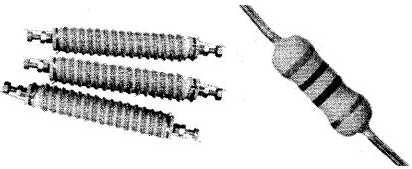
Alloys are used for making standard resistance coil because they have low temperature coefficient of resistance with less temperature sensitivity.

This keeps the resistance of the wire almost constant even in small temperature change. The alloys also have high resistivity and hence high resistance, because for given length and cross-section area of conductor (L and A are constant).
$\text{R}\hat{\text{I}}\pm\text{p}$
art

Download our app
and get started for free

Experience the future of education. Simply download our apps or reach out to us for more information. Let's shape the future of learning together!No signup needed.*

Similar Questions

  • 1
    For the potentiometer circuit shown in the given figure, points X and Y reprensent the two terminals of an unknown emf E'. A student observed that when the jockey in moved from the end A to the end B of the potentiometer wire, the deflection in the galvanometer remains in the same direction.What may be the two possible faults in the circuit that could result in this obsevation?
    If the galvanometer deflection at the end B is (i) more, (ii) less, than that at the end A, which of the two faults, listed above, would be there in the circuit?
    Give reasons in support of your answer in each case.
    View Solution
  • 2
    A potentiometer wire of length 1 m is connected to a driver cell of emf 3 V as shown in the figure. When a cell of 1.5 V emf is used in the secondary circuit, the balance point is found to be 60 cm. On replacing this cell and using a cell of unknown emf, the balance point shifts to 80 cm. 
    1. Calculate unknown emf of the cell.
    2. Explain with reason, whether the circuit works, if the driver cell is replaced with a cell of emf 1 V.
    3. Does the high resistance R, used in the secondary circuit affect the balance point? Justify your answer.
    View Solution
  • 3
    n-identical cells, each of emf $\varepsilon,$ internal resistance r connected in series are charged by a dc source of emf $\varepsilon'$ using a resistance R.
    1. Draw the circuit arrangement.
    2. Deduce expressions for (a) the charging current and (b) the potential difference across the combination of cells.
    View Solution
  • 4
    In the given circuit, with steady current, calculate the potential difference across the capacitor and the charge stored in it.
    View Solution
  • 5
    What are the advantages of the null$-$point method in a Wheatstone bridge? What additional measurements would be required to calculate $R_{unknown}$ by any other method?
    View Solution
  • 6
    A battery of $10 V$ and negligible internal resistance is connected across the diagonally opposite corners of a cubical network consisting of 12 resistors each of resistance $1 \Omega$ (Fig. 3.16). Determine the equivalent resistance of the network and the current along each edge of the cube.
    Image
    View Solution
  • 7
    The following circuit shows the use of potentiometer to measure the internal resistance of a cell:
    1. When the key is open, how does the balance point change, if the current from the driver cell decreases?
    2. When the key K is closed, how does the balance point change if R is increased keeping current from the driver cell constant?
    View Solution
  • 8
    Two heater coils made of same material are connected in parallel across the mains. The length and diameter of the wire of one of coils are double that of the other. Which one of them will produce more heat?
    View Solution
  • 9
    A storage battery of emf $8.0 V$ and internal resistance $0.5\ \Omega$ is being charged by a $120 V\  dc$ supply using a series resistor of $15.5\ \Omega.$ What is the terminal voltage of the battery during charging? What is the purpose of having a series resistor in the charging circuit?
    View Solution
  • 10
    A potential difference $V$ is applied across a conductor of length $L$ and diameter $D.$ How is the drift velocity, $V_d,$ of charge carriers in the conductor affected when $(i) \ V$ is halved, $(ii) \ L$ is doubled and $(iii) \ D$ is halved? Justify your answer in each case.
    View Solution