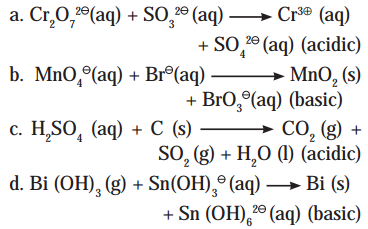
Question
Two processes, which are taking place in opposite directions are in equilibrium. How to write equilibrium constant expersions for heterogeneous equilibrium?
Generate a complete, print-ready paper with questions like this in minutes — across 16+ boards, with answer keys.
| Law | Statement | ||
| i. | Law of definite proportions | a. | When two elements A and B form more than one compounds, the masses of element B that combine with a given mass of A are always in the ratio of small whole numbers |
| ii. | Gay Lussac’s law | b. | Equal volumes of all gases at the same temperature and pressure contain equal number of molecules |
| iii. | Law of multiple proportions | c. | When gases combine or are produced in a chemical reaction they do so in a simple ratio by volume, provided all gases are at same temperature and pressure |
| iv. | Avogadro’s law | d. | A given compound always contains exactly the same proportion of elements by weight |