MCQ
Two projectiles are thrown simultaneously in the same plane from the same point. If their velocities are $v_1$ and $v_2$ at angles $\theta _1$ and $\theta_2$ respectively from the horizontal, then answer the following question

If $v_1\,\,cos\,\,\theta _1 = v_2\,\,cos\,\,\theta _2$, then choose the incorrect statement

  • A
    one particle will remain exactly below or above the other particle
  • B
    the trajectory of one with respect to other will be a vertical straight line
  • both will have the same range
  • D
    none of these

Answer

Correct option: C.
both will have the same range
c

Need a full question paper?

Generate a complete, print-ready paper with questions like this in minutes — across 16+ boards, with answer keys.

Start Generating Free

Similar questions

A rocket has a mass of $100 \,kg$. $90\%$ of this is fuel. It ejects fuel vapours at the rate of $1 \,kg/sec$ with a velocity of $500\, m/sec$ relative to the rocket. It is supposed that the rocket is outside the gravitational field. The initial upthrust on the rocket when it just starts moving upwards  is ......... $N$
$Y = A \sin \left(\omega t +\phi_{0}\right)$ is the time-displacement equation of a SHM. At $t=0$ the displacement of the particle is $Y =\frac{ A }{2}$ and it is moving along negative $x$ -direction. Then the initial phase angle $\phi_{0}$ will be ...... .
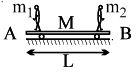
 Two persons of mass $m_1$ and $m_2$ are standing at the two ends $A$ and $B $ respectively, of $a$ trolley of mass $M$ as shown. When the person standing at $A$ jumps from the trolley towards left with urel with respect to the trolley, then
A body starts from rest with uniform acceleration. If its velocity after $n$ second is $\upsilon ,$ then its displacement in the last two seconds is
A body is thrown at angle $30^{\circ}$ to the horizontal with the velocity of $30\; m / s$. After $1\;sec$, its velocity will be (in $m/s$) $\left(g=10\; m / s ^{2}\right)$
The moment of inertia of a solid sphere, about an axis parallel to its diameter and at a distance of $x$ from it, is $I(x)$. Which one of the graphs represents the variation of $I(x)$ with $x$ correctly?
Two cars $P$ and $Q$ start from a point at the same time in a straight line and their positions are represented by $ x_p(t)=at+bt^2 $ and $x_Q(t)= ft- t^2$. At what time do the cars have the same velocity $?$ 
A particle of mass $'\mathrm{m}'$ is projected with a velocity $v=\mathrm{kV}_{\mathrm{e}}(\mathrm{k}\,<\,1)$ from the surface of the earth.

$\left(\mathrm{V}_{\mathrm{e}}=\right.\text { escape velocity) }$

The maximum height above the surface reached by the particle is :

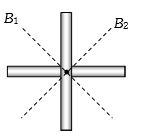
Two identical rods each of mass $M$. and length $l$ are joined in crossed position as shown in figure. The moment of inertia of this system about a bisector would be 
The bulk modulus of rubber is $9.1 \times 10^8\,N/m^2$. To what depth a rubber ball be taken in a lake so that its volume is decreased by $0.1\%$ ? ....... $m$