Question
Two proton beams going in the same direction repel each other whereas two wires carrying currents in the same direction attract each other. Explain.

Answer

Two proton beams going in the same direction repel each other, as they are like charges and we know that like charges repel each other.
When a charge is in motion then a magnetic field is associated with it. Two wires carrying currents in the same direction produce their fields (acting on each other) in opposite directions so the resulting magnetic force acting on them is attractive. Due to the magnetic force, these two wires attract each other.
But when a charge is at rest then only an electric field is associated with it and no magnetic fiels is produced by it. So at rest, it repels a like charge by exerting a electric force on it. Charge in motion can produce both electric field and magnetic field.
The attractive force between two current carrying wires is due to the magnetic field and repulsive force is due to the electric field.
Need a full question paper?

Generate a complete, print-ready paper with questions like this in minutes — across 16+ boards, with answer keys.

Start Generating Free

Similar questions

Answer the following questions:
The earth’s field departs from its dipole shape substantially at large distances (greater than about 30,000 km). What agencies may be responsible for this distortion?
A converging lens of focal length $12\ cm$ and a diverging mirror of focal length $7.5\ cm$ are placed $5.0\ cm$ apart with their principal axes coinciding. Where should an object be placed so that its image falls on itself?
Which part of electromagnetic spectrum is used in satellite communication?
A source emits 45 joules of energy in 15s. What is the radiant flux of the source?
Answer the following questions regarding earth’s magnetism:
If you made a map of magnetic field lines at Melbourne in Australia, would the lines seem to go into the ground or come out of the ground?
Find the thickness of a plate which will produce a change in optical path equal to half the wavelength $\lambda$ of the light passing through it normally. The refractive index of the plate is $\mu$.
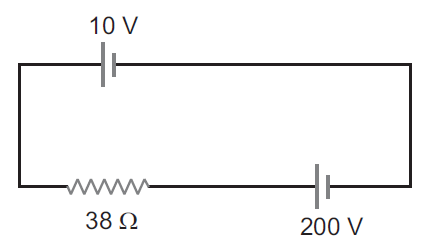
A 10 V battery of negligible internal resistance is connected across a 200 V battery and a resistance of 38 $\Omega$ as shown in the figure. Find the value of the current in circuit.
Write frequency range of the following electromagnetic radiations and state one use of each :(i) Micro wave (ii) Ultraviolet radiation(iii) Gamma rays.
How does conductance of a semi-conductor changes with increase in temperature?
Which of the following is a semi-conductor?
(i) Copper
(ii) Gallium Arsenide
(iii) Sulphur.