MCQ
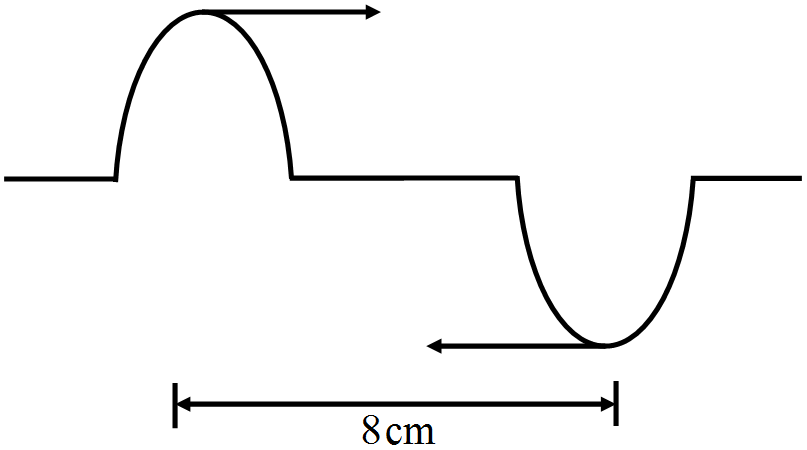
Two pulses in a stretched string whose centres are initially $8 \ cm$ apart are moving towards each other as shown in figure. The speed of each pulse is $2 \ cms^{-1}$. After $2$ second, the total energy of the pulses will be:
  • A
    Zero.
  • Purely kinetic.
  • C
    Purely potential.
  • D
    Partly kinetic and partly potential.

Answer

Correct option: B.
Purely kinetic.

Need a full question paper?

Generate a complete, print-ready paper with questions like this in minutes — across 16+ boards, with answer keys.

Start Generating Free

Similar questions

The height $h$ of the liquid column in a capillary tube on Earth is $h$. On the Moon, where the acceleration due to gravity of earth is $1/6.$ This height is :
$Assertion :$ The buoyant force on a submerged rigid object can be considered to be acting at the centre of mass of the object.
$Reason :$ For a rigid body a force field distributed uniformly through its volume can be considered to be acting at the centre of mass of the body.
$12\,\,gms$ of gas occupy a volume of $4\times 10^{-3}\,\, m^3$ ata temperature of $7\,^oC$. After the gas is heated at constant pressure its density becomes $6\times 10^{-4}\,\,gm/cc$. ...... $K$ temperature to which the gas was heated.
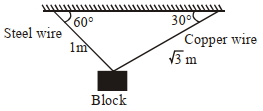
A block of weight $100 N$ is suspended by copper and steel wires of same cross sectional area $0.5 cm ^2$ and, length $\sqrt{3} m$ and $1 m$, respectively. Their other ends are fixed on a ceiling as shown in figure. The angles subtended by copper and steel wires with ceiling are $30^{\circ}$ and $60^{\circ}$, respectively. If elongation in copper wire is $\left(\Delta \ell_{ C }\right)$ and elongation in steel wire is $\left(\Delta \ell_{ s }\right)$, then the ratio $\frac{\Delta \ell_{ C }}{\Delta \ell_{ S }}$ is. . . . . .

[Young's modulus for copper and steel are $1 \times 10^{11} N / m ^2$ and $2 \times 10^{11} N / m ^2$ respectively]

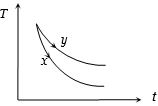
The graph. Shown in the adjacent diagram, represents the variation of temperature $(T)$ of two bodies, $x$ and $y$ having same surface area, with time $(t)$ due to the emission of radiation. Find the correct relation between the emissivity
Two discs of same mass and same thickness have densities as $17 \,g / cm ^3$ and $51 \,g / cm ^3$. The ratio of their moment of inertia about their central axes is .........
A beaker of height $H$ is made up of a material whose coefficient of linear thermal expansion is $3\alpha $ . It is filled up to the brim by a liquid whose coefficient of thermal expansion is $\alpha $. If now the beaker along with its contents is uniformly heated through a small temperature $T$ the level of liquid will reduce by (given $\alpha  << 1$) 
The absolute temperature of a gas is determined by
What is the value of linear velocity, if $\vec \omega = 3\hat i - 4\hat j + \hat k$ and $\vec r = 5\hat i - 6\hat j + 6\hat k$
The specific heat of alcohol is about half that of water. Suppose you have identical masses of alcohol and water. The alcohol is initially at temperature $T_A$. The water is initially at a different temperature $T_W.$ Now the two fluids are mixed in the same container and allowed to come into thermal equilibrium, with no loss of heat to the surroundings. The final temperature of the mixture will be :-