MCQ
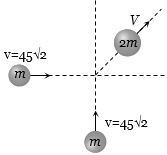
Two putty balls of equal mass moving with equal velocity in mutually perpendicular directions, stick together after collision. If the balls were initially moving with a velocity of $45\sqrt 2 \,m{s^{ - 1}}$ each, the velocity of their combined mass after collision is .................. $\mathrm{m} / \mathrm{s}^{-1}$
  • A
    $45\sqrt 2$
  • $45$
  • C
    $90$
  • D
    $22.5\sqrt 2$

Answer

Correct option: B.
$45$
b
(b)Initial momentum
$\vec P = m45\sqrt 2 \;\hat i + m45\sqrt 2 \;\hat j$ $⇒$ $|\vec P| = m \times 90$
Final momentum $2m \times V$
By conservation of momentum $2m \times V = m \times 90$
$V = 45\,m/s$

Need a full question paper?

Generate a complete, print-ready paper with questions like this in minutes — across 16+ boards, with answer keys.

Start Generating Free

Similar questions

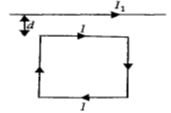
A square loop, carrying a steady current $I,$ is placed in a horizontal plane near a long straight conductor carrying a steady current $I_1$ at a distance $d$ from the conductor as shown in figure. The loop will experience
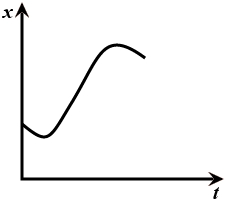
The accompanying graph of position $x$ versus time $t$ represents the motion of a particle. If $p$ and $q$ are both positive constants, the expression that best describes the acceleration $a$ of the particle is
Match the corresponding entries of column $I$  with column $II$. [Where $m$ is the magnification produced by the mirror]

 $\begin{array}{|l|l|} \hline Column\,\,-I  & Column\,\,-\,\,II\,\, \\ \hline 1.\,\,m=-2  & a.\,\,Convex\,\,mirror \\ \hline 2.\,\,m=\,\,\frac{-1}{2} & b.\,\,Concave\,\,mirror \\ \hline 3.\,\,m=+2  & c.\,\,Real\,\,Image \\ \hline 4.\,\,m=\,\,\frac{+1}{2} & d.\,\,Virtual\,\,image \\ \hline \end{array}$

Match List $I$ with List $II$ of Electromagnetic waves with corresponding wavelength range :

List $I$ List $II$
$(A)$ Microwave $(I)$ $400\,nm$ to $1\,nm$
$(B)$ Ultraviolet $(II)$ $1\,nm$ to $10^{-3}\,nm$
$(C)$ $X-$Ray $(III)$ $1\,mn$ to $700\,nm$
$(D)$ Infra-red $(IV)$ $0.1\,m$ to $1\,mm$

Choose the correct answer from the options given below:

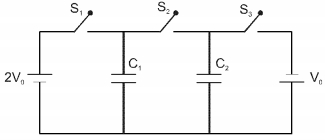
In the circuit shown in the figure, there are two parallel plate capacitors each of capacitance $C$. The switch $S _1$ is pressed first to fully charge the capacitor $C_1$ and then released. The switch $S_2$ is then pressed to charge the capacitor $C _2$. After some time, $S _2$ is released and then $S _3$ is pressed. After some time.

$(A)$ the charge on the upper plate of $C _1$ is $2 CV _0$

$(B)$ the charge on the upper plate of $C _1$ is $CV _0$

$(C)$ the charge on the upper plate of $C _2$ is $0$

$(D)$ the charge on the upper plate of $C _2$ is $- CV _0$

Two rods one made of copper and other made of steel of the same length and same cross sectional area are joined together. The thermal conductivity of copper and steel are $385\,J\,s ^{-1}\,K ^{-1}\,m ^{-1}$ and $50\,J\,s ^{-1}\,K ^{-1}\,m ^{-1}$ respectively. The free ends of copper and steel are held at $100^{\circ}\,C$ and $0^{\circ}\,C$ respectively. The temperature at the junction is, nearly $.......^{\circ}\,C$
The expression $\left( {\frac{1}{{\sqrt 2 }}\hat i + \frac{1}{{\sqrt 2 }}\hat j} \right)$ is a
One circular ring and one ciruclar disc, both are having the same mass and radius. the ratio of their moments of inertia about the axes passing through their centres and perpendicular to their planes, will be
A sphere of mass $m$ is set in motion with initial velocity $v_o$ on a surface on which $kx^n$ is the frictional force with $k$ and $n$ as the constants and $x$ as the distance from the point of start. Find the distance in which sphere will stop
A solid sphere of mass $‘M’$ and radius $‘a’$ is surrounded by a uniform concentric spherical shell of thickness $2a$ and mass $2M.$ The gravitational field at distance $‘3a’$ from the centre will be