Question
Two rays A and B being reflected by a mirror and going as A' and B'. The mirror:
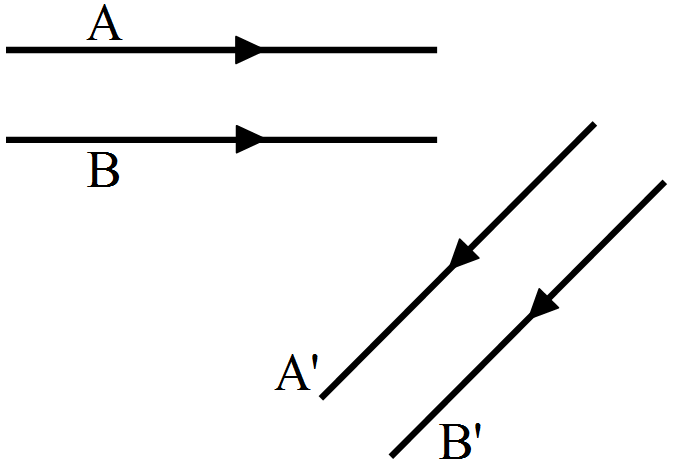
- Is plane.
- Is convex.
- Is concave.
- May be any spherical mirror.
Explanation:
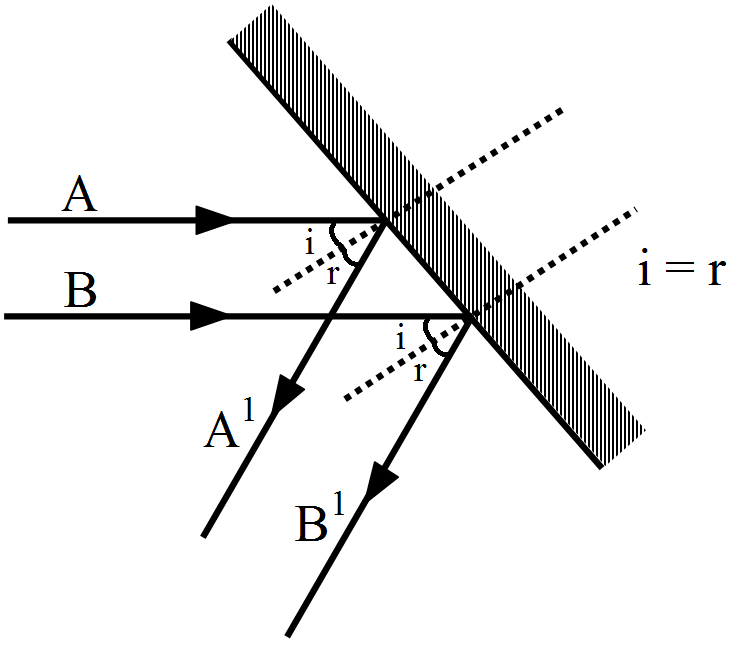
Here initially A & B is parallel to each other after reflection by teh plane mirror A' & B' goes Parallel to each other.
Generate a complete, print-ready paper with questions like this in minutes — across 16+ boards, with answer keys.
In a mean life of a radioactive sample
|
(a) About 1/3 of substance disintegrates |
|
(b) About 2/3 of the substance disintegrates |
|
(c) About 90% of the substance disintegrates |
|
(d) Almost all the substance disintegrates |
Assertion : The positively charged nucleus of an atom has a radius of almost  .
.
Reason : In a-particle scattering experiment, the distance of closest approach for a-particles is 
|
(a) If both assertion and reason are true and the reason is the correct explanation of the assertion. |
|
(b) If both assertion and reason are true but reason is not the correct explanation of the assertion. |
|
(c) If assertion is true but reason is false. |
|
(d) If the assertion and reason both are false. |
Kirchoff’s I law and II law of current, proves the
|
(a) Conservation of charge and energy |
|
(b) Conservation of current and energy |
|
(c) Conservation of mass and charge |
|
(d) None of these |
A cube of side l is placed in a uniform field E, where E = E . The net electric flux through the cube is
|
(a) Zero |
(b) |
(c) 4 |
(d) 6 |
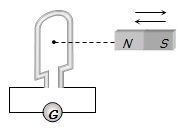
When a magnet is pushed in and out of a circular coil C connected to a very sensitive galvanometer G as shown in the adjoining diagram with a frequency v, then
|
(a) Constant deflection is observed in the galvanometer |
|
(b) Visible small oscillations will be observed in the galvanometer if v is about 50 Hz |
|
(c) Oscillations in the deflection will be observed clearly if v = 1 or 2 Hz |
|
(d) No variation in the deflection will be seen if v = 1 or 2 Hz |
In a dc motor, induced e.m.f. will be maximum
|
(a) When motor takes maximum speed |
(b) When motor starts rotating |
|
(c) When speed of motor increases |
(d) When motor is switched off |
If a glass prism is dipped in water, its dispersive power:

