Two resistances ${R_1}$ and ${R_2}$ are made of different materials. The temperature coefficient of the material of ${R_1}$ is $\alpha $ and of the material of ${R_2}$ is $ - \beta $. The resistance of the series combination of ${R_1}$ and ${R_2}$ will not change with temperature, if ${R_1}/{R_2}$ equals
Diffcult


Download our appand get started for free
Experience the future of education. Simply download our apps or reach out to us for more information. Let's shape the future of learning together!No signup needed.*
Similar Questions
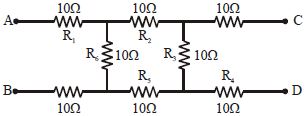
- 1The equivalent resistance between the points $A$ and $D$ ................ $\Omega$View Solution
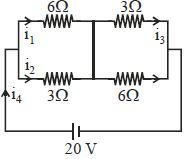
- 2View SolutionDiagram shows a circuit diagram choose incorrect statement
- 3A potentiometer has uniform potential gradient across it. Two cells connected in series $(i)$ to support each other and $(ii)$ to oppose each other are balanced over $6\,m$ and $2\,m$ respectively on the potentiometer wire. The $e.m.f.$’s of the cells are in the ratio ofView Solution
- 4A $d.c.$ main supply of $e.m.f.\, 220\, V$ is connected across a storage battery of $e.m.f.\, 200\, V$ through a resistance of $1\,\Omega $. The battery terminals are connected to an external resistance $'R'$ . The minimum value of $'R'$, so that a current passes through the battery to charge it is ............... $\Omega$View Solution
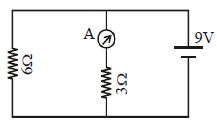
- 5In the figure shown, if the internal resistance of the battery is $1\, ohm$ , the reading of the ammeter will be ................. $\mathrm{A}$View Solution
- 6When $5\ V$ potential difference is applied across a wire of length $0.1\ m$, the drift speed of electrons is $2.5 \times 10^{-4}$ $ms^{-1}$ . If the electron density in the wire is $8 \times 10^{28}$ $m^{-3}$ the resistivity of the material is close toView Solution
- 7View SolutionThrough a semiconductor, an electric current is due to drift of
- 8A copper wire of diameter $1.02\, mm$ carries a current of $1.7\, amp$. Find the drift velocity $(v_d)$ of electrons in the wire. Given $n$, number density of electrons in copper $= 8.5 \times 10^{27} /m^3$....................... $mm/sec$View Solution
- 9In india electricity is supplied for domestic use at $220\,\,V$. It is supplied at $110\,\, V$ in $USA$. If resistance of $60\,\, W$ bulb for use in India is $R$, then the resistance of $60\,\, W$ bulb for use in $USA$ will beView Solution
- 10A current of $5\, A$ passes through a copper conductor (resistivity $= 1.7\times10^{-8}\,\Omega \,m$) of radius of cross-section $5\, mm$. Find the mobility of the charges if their drift velocity is $1.1\times10^{-3}\, m/s$ ................ $m^2/Vs$View Solution