Through a semiconductor, an electric current is due to drift of
Easy


Download our appand get started for free
Experience the future of education. Simply download our apps or reach out to us for more information. Let's shape the future of learning together!No signup needed.*
Similar Questions
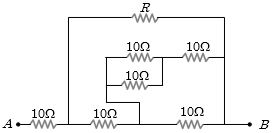
- 1For what value of $R$ the net resistance of the circuit will be $18\, ohms$ ............... $\Omega$View Solution
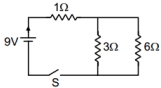
- 2After switch is closed, current drawn from the battery is (in $A$)View Solution
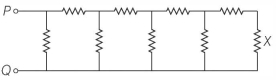
- 3Consider the circuit shown below where all resistors are $1 \,k \Omega$. If a current of magnitude $1 \,mA$ flows through the resistor marked $X$, the potential difference measured between points $P$ and $Q$ are ..............$V$View Solution
- 4A $100\, V$ voltmeter of internal resistance $20\,k\Omega $ in series with a high resistance $R$ is connected to a $110\, V$ line. The voltmeter reads $5\, V$, the value of $R$ is ................ $k \Omega $View Solution
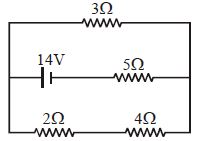
- 5Find out current in $3\,\Omega $ resistance in given circuitView Solution
- 6$E$ denotes electric field in a uniform conductor, $I$ corresponding current through it, ${v_d}$ drift velocity of electrons and $P$ denotes thermal power produced in the conductor, then which of the following graph is incorrectView Solution
- 7Forty electric bulbs are connected in series across a $220\, V$ supply. After one bulb is fused, the remaining $39$ are connected again in series across the same supply. The illumination will beView Solution
- 8An unknown resistance $R_1$ is connected in series with a resistance of $10 \,\Omega$. This combinations is connected to one gap of a meter bridge while a resistance $R_2$ is connected in the other gap. The balance point is at $50\, cm$. Now, when the $10 \,\Omega$ resistance is removed the balance point shifts to $40\, cm$. The value of $R_1$ is (in $ohm$)View Solution
- 9By what percentage will the illumination of the lamp decrease if the current drops by $20 \%$ ?View Solution
- 10If $2.2\,kW$ power is transmitted through a $100\,\Omega $ line at $22,000\,V,$ the power loss in the form of heat will be ............. $W$View Solution