MCQ
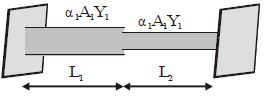
Two rods are joined between fixed supports as shown in the figure. Condition for no change in the lengths of individual rods with the increase of temperature will be

( ${\alpha _1},\,{\alpha _2},$ = linear expansion coefficient

$A_1, A_2$ = Area of rods

$Y_1, Y_2$ = Young modulus)
  • A
    $\frac{{{A_1}}}{{{A_2}}}\, = \,\frac{{{\alpha _1}{Y_1}}}{{{\alpha _2}{Y_2}}}$
  • B
    $\frac{{{A_1}}}{{{A_2}}}\, = \,\frac{{{L_1}{\alpha _1}{Y_1}}}{{{L_2}{\alpha _2}{Y_2}}}$
  • C
    $\frac{{{A_1}}}{{{A_2}}}\, = \,\frac{{{L_2}{\alpha _2}{Y_2}}}{{{L_1}{\alpha _1}{Y_1}}}$
  • $\frac{{{A_1}}}{{{A_2}}}\, = \,\frac{{{\alpha _2}{Y_2}}}{{{\alpha _1}{Y_1}}}$
Answer

Correct option: D.
$\frac{{{A_1}}}{{{A_2}}}\, = \,\frac{{{\alpha _2}{Y_2}}}{{{\alpha _1}{Y_1}}}$
d
$Y=\frac{\text { Stress }}{\text { Strain }}=\frac{T / A}{\Delta l / l}$

$\mathrm{T}=\frac{\mathrm{Y} \Delta l}{l}=\mathrm{A}=\mathrm{Y} \cdot \mathrm{A} \alpha \Delta \mathrm{T}$

In both the rods tension will be some so

$\mathrm{T}_{1}=\mathrm{T}_{2},$ Hence $\mathrm{Y}_{1} \mathrm{A}_{1} \alpha_{1} \Delta \mathrm{T}=\mathrm{Y}_{2} \mathrm{A}_{2} \alpha_{2} \Delta \mathrm{T}$

$\frac{A_{1}}{A_{2}}=\frac{Y_{2} \alpha_{2}}{Y_{1} \alpha_{1}}$

Need a full question paper?

Generate a complete, print-ready paper with questions like this in minutes — across 16+ boards, with answer keys.

Start Generating Free

Similar questions

Three conducting rods of same material and cross section are shown in figure. Temperature at $A,D$ and $C$ are maintained at $20\ ^oC, 90\ ^oC$ and $0\ ^oC$. The ratio of lengths of $BD$ and $BC$ if there is no heat. Flows in $AB$ is
An object while moving may not have:
Consider a gas for which diameter of molecules is $\sigma $ , the gas is at a pressure $P$ and temperature $T$ and $N_a =$ avagodro’s number. The mean free path along $x$ axis is 
Starting from rest, acceleration of a particle is $a = 2(t - 1).$ The velocity of the particle at $t = 5\,s$ is.........$m/sec$
A body of mass $m$ is moving in a circular orbit of radius $R$ about a planet of mass $M$. At some instant, it splits into two equal masses. The first mass moves in a circular orbit of radius $\frac{R}{2}$ , and the other mass, in a circular orbit of radius $\frac{3R}{2}$. The difference between the final and initial total energies is
A spring is stretched by $0.20\, m$, when a mass of $0.50\, kg$ is suspended. When a mass of $0.25\, kg$ is suspended, then its period of oscillation will be .... $\sec$   $(g = 10\,m/{s^2})$
What is the restoring force proportional to in simple harmonic motion?
What will be the velocity v/s time graph of a ball falling from a height before hitting the ground look like?
A particle is moving along the $x-$axis with its coordinate with the time '$t$' given be $\mathrm{x}(\mathrm{t})=10+8 \mathrm{t}-3 \mathrm{t}^{2} .$ Another particle is moving the $y-$axis with its coordinate as a function of time given by $\mathrm{y}(\mathrm{t})=5-8 \mathrm{t}^{3} .$ At $\mathrm{t}=1\; \mathrm{s},$ the speed of the second particle as measured in the frame of the first particle is given as $\sqrt{\mathrm{v}} .$ Then $\mathrm{v}$ (in $\mathrm{m} / \mathrm{s})$ is
The dimensions of resistivity in terms of $M,\,L,\,T$ and $Q$ where $Q$ stands for the dimensions of charge, is