Two rods having thermal conductivity in the ratio of $5 : 3$ having equal lengths and equal cross-sectional area are joined by face to face. If the temperature of the free end of the first rod is $100°C$ and free end of the second rod is $20°C$ . Then temperature of the junction is...... $^oC$
Medium
Download our app for free and get started
(a) Temperature of interface $\theta = \frac{{{K_1}{\theta _1} + {K_2}{\theta _2}}}{{{K_1} + {K_2}}}$
It is given that $\frac{{{K_1}}}{{{K_2}}} = \frac{5}{3}$
It is given that $\frac{{{K_1}}}{{{K_2}}} = \frac{5}{3}$
==> ${K_1} = 5K$ and ${K_2} = 3K$
$\theta = \frac{{5K \times 100 + 3K \times 20}}{{5K + 3K}}$$ = \frac{{560K}}{{8K}}=70°C$

Download our appand get started for free
Experience the future of education. Simply download our apps or reach out to us for more information. Let's shape the future of learning together!No signup needed.*
Similar Questions
- 1The outer faces of a rectangular slab made of equal thickness of iron and brass are maintained at $100^{\circ} C$ and $0^{\circ} C$ respectively. The temperature at the interface is ........... $^{\circ} C$ (Thermal conductivity of iron and brass are $0.2$ and $0.3$ respectively.)View Solution
- 2View SolutionA solid cube and a solid sphere of identical material and equal masses are heated to the same temperature and left to cool in the same surroundings. Then,
- 3A body takes $4\, {min}$. to cool from $61^{\circ} {C}$ to $59^{\circ} {C}$. If the temperature of the surroundings is $30^{\circ} {C}$, the time taken by the body to cool from $51^{\circ} {C}$ to $49^{\circ} {C}$ is $....\,min$View Solution
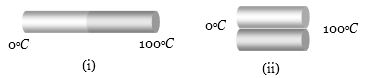
- 4Two identical square rods of metal are welded end to end as shown in figure $(i)$ , $20$ calories of heat flows through it in $4$ minutes. If the rods are welded as shown in figure $(ii)$, the same amount of heat will flow through the rods in ....... $\min.$View Solution
- 5A body takes $5$ minutes for cooling from ${50^o}C$ to ${40^o}C.$ Its temperature comes down to ${33.33^o}C$ in next $5$ minutes. Temperature of surroundings is ....... $^oC$View Solution
- 6The two ends of a rod of length $L$ and a uniform cross-sectional area $A$ are kept at two temperatures $T_1$ and $T_2 (T_1 > T_2)$. The rate of heat transfer,$\frac{ dQ }{dt}$, through the rod in a steady state is given byView Solution
- 7The sun radiates electromagnetic energy at the rate of $3.9 \times 10^{26}\,W$. It's radius is $6.96 \times 10^8\,m$. The intensity of sun light at the solar surface will be (in $W/m^2$)View Solution
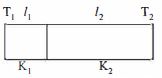
- 8One end of a thermally insulated rod is kept at a temperature $T_1$ and the other at $T_2$ . The rod is composed of two sections of length $l_1$ and $l_2$ and thermal conductivities $K_1$ and $K_2$ respectively. The temperature at the interface of the two section isView Solution
- 9The radiation emitted by a star $A$ is $10,000$ times that of the sun. If the surface temperatures of the sun and the star $A$ are $6000 K$ and $2000 K$ respectively, the ratio of the radii of the star $A$ and the sun isView Solution
- 10A metallic sphere cools from $50^{\circ} C$ to $40^{\circ} C$ in $300 \,s.$ If atmospheric temperature around is $20^{\circ} C ,$ then the sphere's temperature after the next $5$ minutes will be close to$.....C$View Solution