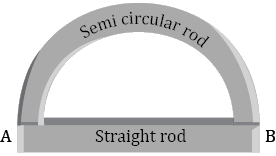
Two rods (one semi-circular and other straight) of same material and of same cross-sectional area are joined as shown in the figure. The points $A$ and $B$ are maintained at different temperature. The ratio of the heat transferred through a cross-section of a semi-circular rod to the heat transferred through a cross section of the straight rod in a given time is
Medium


Download our appand get started for free
Experience the future of education. Simply download our apps or reach out to us for more information. Let's shape the future of learning together!No signup needed.*
Similar Questions
- 1View SolutionIf a black body is heated at a high temperature, it seems to be
- 2A cup of tea cools from $80\,^oC$ to $60\,^oC$ in one minute. The ambient temperature is $30\,^oC$. In cooling from $60\,^oC$ to $50\,^oC$, it will take ....... $\sec$View Solution
- 3Consider two rods of same length and different specific heats $\left(S_{1}, S_{2}\right)$, conductivities $\left(K_{1}, K_{2}\right)$ and area of cross-sections $\left(A_{1}, A_{2}\right)$ and both having temperatures $T_{1}$ and $T_{2}$ at their ends. If rate of loss of heat due to conduction is equal, thenView Solution
- 4If the absorption and reflection co-efficients of a surface of a body are $0.4$ and $0.6$ respectively, thenView Solution
- 5The temperature of a piece of iron is ${27^o}C$ and it is radiating energy at the rate of $Q\;kW{m^{ - 2}}$. If its temperature is raised to ${151^o}C$, the rate of radiation of energy will become approximately ....... $Q\,kW\,{m^{ - 2}}$View Solution
- 6A black body, at a temperature of $227\,^oC$ radiates heat at a rate of $7\,cal\,cm^{-2}\, s^{-1}$ . At a temperature of $727\,^oC$ , the rate of heat radiated in the same units will beView Solution
- 7Two stars emit maximum radiation at wavelength $3600Å$ and $4800Å$ respectively. The ratio of their temperatures isView Solution
- 8A liquid cools down from ${70^o}C$ to ${60^o}C$ in $5$ minutes. The time taken to cool it from ${60^o}C$ to ${50^o}C$ will beView Solution
- 9Many exoplanets have been discovered by the transit method, where in one monitors, a dip in the intensity of the parent star as the exoplanet moves in front of it. The exoplanet has a radius $R$ and the parent star has radius $100 \,R$. If $I_0$ is the intensity observed on earth due to the parent star, then as the exoplanet transitsView Solution
- 10If the temperature of a hot body is increased by $50\%$ then the increase in the quantity of emitted heat radiation will be ..... $\%$View Solution