A black body, at a temperature of $227\,^oC$ radiates heat at a rate of $7\,cal\,cm^{-2}\, s^{-1}$ . At a temperature of $727\,^oC$ , the rate of heat radiated in the same units will be
Medium


Download our appand get started for free
Experience the future of education. Simply download our apps or reach out to us for more information. Let's shape the future of learning together!No signup needed.*
Similar Questions
- 1View SolutionThe rate of radiation of energy from a hot object is maximum, if its surface is ...........
- 2Ice starts forming in lake with water at ${0^o}C$ and when the atmospheric temperature is $ - {10^o}C$. If the time taken for $1 \;cm$ of ice be $7$ hours, then the time taken for the thickness of ice to change from $1\; cm$ to $2\; cm$ isView Solution
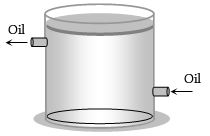
- 3The top of insulated cylindrical container is covered by a disc having emissivity $0.6$ and thickness $1\, cm$. The temperature is maintained by circulating oil as shown in figure. If temperature of upper surface of disc is $127^o C$ and temperature of surrounding is $27^o C$, then the radiation loss to the surroundings will be (Take $\sigma = \frac{{17}}{3} \times {10^{ - 8}}W/{m^2}{K^4})$View Solution
- 4Temperature of water at the surface of lake is $ - {20^o}C$ Then temperature of water just below the lower surface of ice layer is ...... $^oC$View Solution
- 5View SolutionCooling law is based upon
- 6The rectangular surface of area $8$ cm $ \times $ 4cm of a black body at a temperature of ${127^o}C$ emits energy at the rate of $E$ per second. If the length and breadth of the surface are each reduced to half of the initial value and the temperature is raised to ${327^o}C$, the rate of emission of energy will becomeView Solution
- 7A planet of radius $R_{p}$ is revolving around a star of radius $R^{*}$, which is at temperature $T^{*}$. The distance between the star and the planet is $d$. If the planet's temperature is $f T^{*}$, then $f$ is proportional toView Solution
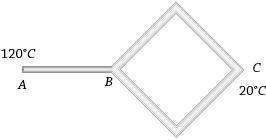
- 8Five identical rods are joined as shown in figure. Point $A$ and $C$ are maintained at temperature $120^o C$ and $20^o C$ respectively. The temperature of junction $B$ will be....... $^oC$View Solution
- 9View SolutionThe dimensions of thermal resistance are
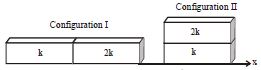
- 10Two rectangular blocks, having identical dimensions, can be arranged either in configuration $I$ or in configuration $II$ as shown in the figure. One of the blocks has thermal conductivity $k$ and the other $2k$. The temperature difference between the ends along the $x-$ axis is the same in both the configurations. It takes $9s$ to transport a certain amount of heat from the hot end to the cold end in the configuration $I$. The time to transport the same amount of heat in the configuration $II$ is .......... $\sec$View Solution