Question
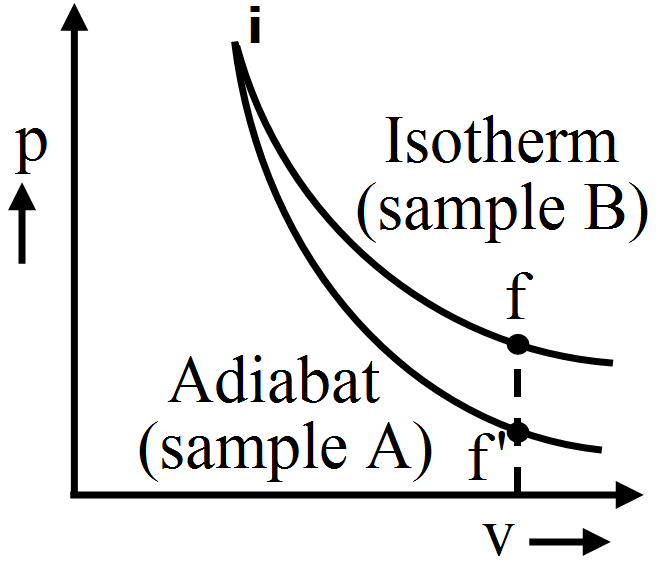
Two samples A and B are initially kept in the same state. Sample A is expanded through an adiabatic process and the sample B through an isothermal process. The final volumes of the samples are the same. The final pressures in A and B are pA and prespectively.
  1. pA > pB
  2. pA = pB
  3. pA < pB
  4. The relation between pA and pB cannot be deduced.
Answer

  1. pA < pB

Explanation:

Let the initial states of samples A and B be i and the final states of samples B and A be f and f', respectively. Let the final volumes of both be Vo. As sample A is expanded through an adiabatic process, its curve in the p-V diagram is steeper than that of sample B, which is expanded through an isothermal process. Therefore, from the p-V diagram, pA < pB.

Need a full question paper?

Generate a complete, print-ready paper with questions like this in minutes — across 16+ boards, with answer keys.

Start Generating Free

Similar questions

In the resonance tube experiment, first resonant length is $l_1$ and second  resonant length is $l_2$ then the third resonant length will be
By doubling the amplitude of a simple pendulum, the maximum value of its swing will be how many times ?
If the length of stretched string is shortened by $40\%$ and the tension is increased by $44\%$, then the ratio of the final and initial fundamental frequencies is
The position vector of a particle changes with time according to the relation $\vec r\left( t \right) = 15{t^2}\hat i + \left( {4 - 20{t^2}} \right)\hat j$. What is the magnitude of the acceleration at $t = 1$ ?
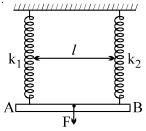
Two light vertical springs with equal natural lengths and spring constants $k_1$ and $k_2$ are separated by a distance $l$. Their upper ends are fixed to the ceiling and their lower ends to the ends $A$ and $B$ of a light horizontal rod $AB$. $A$ vertical downwards force $F$ is applied at point $C$ on the rod. $AB$ will remain horizontal in equilibrium if the distance $AC$ is 
A body of mass 10kg is acted upon by two perpendicular forces, 6N and 8N. The resultant acceleration of the body is:
  1. 1m s–2  at an angle of 1 4 $\tan^{-1}\Big(\frac{4}{3}\Big)$ w.r.t. 6N force.
  2. 0.2m s–2 at an angle of $\tan^{-1}\Big(\frac{4}{3}\Big)$ w.r.t. 6N force.
  3. 1m s–2 at an angle of $\tan^{-1}\Big(\frac{4}{3}\Big)$ w.r.t.8N force.
  4. 0.2m s–2 at an angle of $\tan^{-1}\Big(\frac{4}{3}\Big)$ w.r.t.8N force.
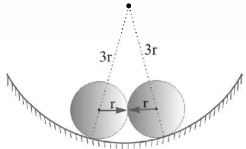
Two equal heavy spheres, each of radius $r$, are in equilibrium within a smooth cup of radius $3 r$. The ratio of reaction between the cup and one sphere and that between the two sphere is
A rope of length $10\, m$ and linear density $0.5\, kg/m$ is lying lengthwise on a smooth horizontal floor. It is pulled by a force of $25\, N$. The tension in the rope at a point $8\, m$ away from the point of application is ....... $N$
Which of the following physical quantities have the same dimensions?
The metallic bob of a simple pendulum has the relative density $\rho$. The time period of this pendulum is $T$. If the metallic bob is immersed in water, then the new time period is given by