Question
Two satellites of equal masses, which can be considered as particles, are orbiting the earth at different heights. Will their moments of inertia be same or different?

Answer

Different. The satellite at larger height has more moment of inertia. Since $I = mass \times (distance)^2$.

Need a full question paper?

Generate a complete, print-ready paper with questions like this in minutes — across 16+ boards, with answer keys.
Start Generating Free

Similar questions

A wave pulse passing on a string with a speed of 40cm/s in the negative x-direction has its maximum at x = 0 at t = 0. Where will this maximum be located at t = 5s?
Suppose a charged particle moves with a velocity v near a wire carrying an electric current. A magnetic force, therefore, acts on it. If the same particle is seen from a frame moving with velocity v in the same direction, the charge will be found at rest. Will the magnetic force become zero in this frame? Will the magnetic field become zero in this frame?
If the value of each of the units of force and length is doubled, then how many times will the value of the unit of energy become?
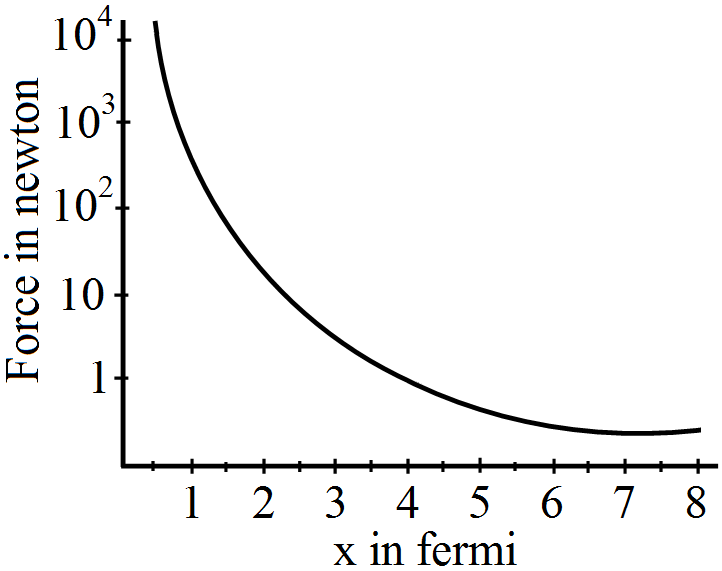
Suppose the magnitude of Nuclear force between two protons varies with the distance between them as shown in figure. Estimate the ratio "Nuclear force$/$Coulomb force" for:
  1. $x = 8fm$
  2. $x = 4fm$
  3. $x = 2fm$
  4. $x = 1fm (1fm = 10^{-15}m)$.
Calorimeters are made of metals not glass. Why?
Two masses are in the ratio 1 : 5. What is the ratio of their inertia?
A person is standing still on frictionless ice in the middle of a frozen pond, how will be reach the shore?
Name the type of motion associated with the molecules of a gas.
A cube of iron (density $=8000 \mathrm{~kg} \mathrm{~m}^{-3}$, specific heat capacity $=470 \mathrm{Jg}^{-1} \mathrm{~K}^{-1}$ ) is heated to a high temperature and is placed on a large block of ice at $0^{\circ} \mathrm{C}$. The cube melts the ice below it, displaces the water and sinks. In the final equilibrium position, its upper surface just goes inside the ice. Calculate the initial temperature of the cube. Neglect any loss of heat outside the ice and the cube. The density of ice $=900 \mathrm{~kg} \mathrm{~m}^{-3}$ and the latent heat of fusion of ice = $3.36 \times 10^5 \mathrm{~J} \mathrm{~kg}^{-1}$.
Why does air bubble in a liquid rise up?