Question
Two semiconductor materials X and Y shown in the given figure, are made by doping germanium crystal with indum and arsenic respectively. The two are joined end to end and connected to a battery as shown.
  1. Will the junction be forward biased or reverse biased?
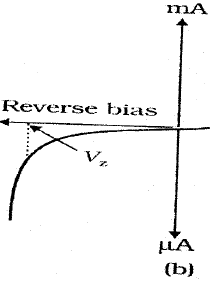
  2. Sketch a V-I graph for this arrangement.

Answer

(If X and Y are correctly identified but the identification of biasing is incorrect or  not given at all, award.)

$(\text{X}\rightarrow\text{p} \text{Type})$

$(\text{Y}\rightarrow\text{n} \text{Type})$

  1. Reverse biased.
  2. Graph:

Need a full question paper?

Generate a complete, print-ready paper with questions like this in minutes — across 16+ boards, with answer keys.

Start Generating Free

Similar questions

A light bulb is rated at $100 W$ for a $220 V$ supply. Find (a) the resistance of the bulb; (b) the peak voltage of the source; and (c) the rms current through the bulb.
The coil of a moving-coil galvanometer keeps on oscillating for a long time if it is deflected and released. If the ends of the coil are connected together, the oscillation stops at once. Explain
An open organ pipe has a length of 5cm.
  1. Find the fundamental frequency of vibration of this pipe.
  2. What is the highest harmonic of such a tube that is in the audible range? Speed of sound in air is 340m/s and the audible range is 20-20,000Hz.
Sketch the magnetic field lines for a current-carrying circular loop near its centre. Replace the loop by an equivalent magnetic dipole and sketch the magnetic field lines near the centre of the dipole. Identify the difference.
A metre scale is graduated at every millimetre. How many significant digits will be there in a length measurement with this scale?
Give the characteristics of an electric field.
Write the uses of capacitors.
If an object far away from a convex mirror moves towards the mirror, the image also moves. Does it move faster, slower or at the same speed as compared to the object?
Two concentric spherical shells have masses M1, M2 and radii R1, R2 (R1, < R2). What is the force exerted by this system on a particle of mass m1 if it is placed at a distance $\frac{\text{R}_1+\text{R}_2}{2}$ from the centre?
If you jump barefooted on a hard surface, your legs get injured. But they are not injured if you jump on a soft surface like sand or pillow. Explain.