Two similar wires under the same load yield elongation of $0.1$ $mm$ and $0.05$ $mm$ respectively. If the area of cross- section of the first wire is $4m{m^2},$ then the area of cross section of the second wire is..... $mm^2$
Medium


Download our appand get started for free
Experience the future of education. Simply download our apps or reach out to us for more information. Let's shape the future of learning together!No signup needed.*
Similar Questions
- 1A uniform heavy rod of mass $20\,kg$. Cross sectional area $0.4\,m ^{2}$ and length $20\,m$ is hanging from a fixed support. Neglecting the lateral contraction, the elongation in the rod due to its own weight is $x \times 10^{-9} m$. The value of $x$ isView Solution
(Given. Young's modulus $Y =2 \times 10^{11} Nm ^{-2}$ અને $\left.g=10\, ms ^{-2}\right)$
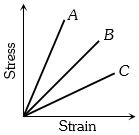
- 2The stress-strain curves for brass, steel and rubber are shown in the figure. The lines $A, B$ and $C$ are forView Solution
- 3A solid sphere of radius $r$ made of a soft material of bulk modulus $K$ is surrounded by a liquid in a cylindrical container. A massless piston of area $a$ floats on the surface of the liquid, covering entire crosssection of cylindrical container. When a mass $m$ is placed on the surface of the piston to compress the liquid, the fractional decrement in the radius of the sphere, $\left( {\frac{{dr}}{r}} \right)$ isView Solution
- 4The upper end of a wire $1\,m$ long and $4\,mm$ radius is clamped. The lower end is twisted by an angle of $30^o$. The angle of shear is ...... $^o$View Solution
- 5The ratio of lengths of two rods $A$ and $B$ of same material is $1 : 2$ and the ratio of their radii is $2 : 1$, then the ratio of modulus of rigidity of $A$ and $B$ will beView Solution
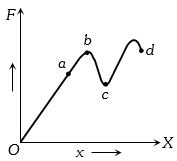
- 6The graph is drawn between the applied force $F$ and the strain $(x)$ for a thin uniform wire. The wire behaves as a liquid in the partView Solution
- 7A uniform cube is subjected to volume compression. If each side is decreased by $1\%,$ then bulk strain isView Solution
- 8Two rods of different materials having coefficients of linear expansion ${\alpha _1},\,{\alpha _2}$ and Young's moduli ${Y_1}$ and ${Y_2}$ respectively are fixed between two rigid massive walls. The rods are heated such that they undergo the same increase in temperature. There is no bending of rods. If ${\alpha _1}:{\alpha _2} = 2:3$, the thermal stresses developed in the two rods are equally provided ${Y_1}:{Y_2}$ is equal toView Solution
- 9A boy’s catapult is made of rubber cord which is $42\, cm$ long, with $6\, mm$ diameter of cross -section and of negligible mass. The boy keeps a stone weighing $0.02\, kg$ on it and stretches the cord by $20\, cm$ by applying a constant force. When released, the stone flies off with a velocity of $20\, ms^{-1}$. Neglect the change in the area of cross section of the cord while stretched. The Young’s modulus of rubber is closest toView Solution
- 10A steel wire can sustain $100\,kg$ weight without breaking. If the wire is cut into two equal parts, each part can sustain a weight of ......... $kg$View Solution