The ratio of lengths of two rods $A$ and $B$ of same material is $1 : 2$ and the ratio of their radii is $2 : 1$, then the ratio of modulus of rigidity of $A$ and $B$ will be
Easy


Download our appand get started for free
Experience the future of education. Simply download our apps or reach out to us for more information. Let's shape the future of learning together!No signup needed.*
Similar Questions
- 1A steel wire of length $3.2 m \left( Y _{ S }=2.0 \times 10^{11}\,Nm ^{-2}\right)$ and a copper wire of length $4.4\,M$ $\left( Y _{ C }=1.1 \times 10^{11}\,Nm ^{-2}\right)$, both of radius $1.4\,mm$ are connected end to end. When stretched by a load, the net elongation is found to be $1.4\,mm$. The load applied, in Newton, will be. (Given $\pi=\frac{22}{7}$)View Solution
- 2A material has Poisson's ratio $0.5$. If a uniform rod of it suffers a longitudinal strain of $3 \times 10^{-3}$, what will be percentage increase in volume is .......... $\%$View Solution
- 3View SolutionIn which case there is maximum extension in the wire, if same force is applied on each wire
- 4Longitudinal stress of $1\,kg/m{m^2}$ is applied on a wire. The percentage increase in length is $(Y = {10^{11}}\,N/{m^2})$View Solution
- 5On all the six surfaces of a unit cube, equal tensile force of $F$ is applied. The increase in length of each side will be ($Y =$ Young's modulus, $\sigma $= Poission's ratio)View Solution
- 6View SolutionUnder elastic limit the stress is
- 7Compressibility per unit atm. pressure of water is $'\sigma '$ and if due to pressure $P$ there is decrement in volume $V$, find change is volumeView Solution
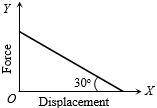
- 8The value of force constant between the applied elastic force $F$ and displacement will beView Solution
- 9The density and breaking stress of a wire are $6 \times$ $10^4 \mathrm{~kg} / \mathrm{m}^3$ and $1.2 \times 10^8 \mathrm{~N} / \mathrm{m}^2$ respectively. The wire is suspended from a rigid support on a planet where acceleration due to gravity is $\frac{1^{\text {rd }}}{3}$ of the value on the surface of earth. The maximum length of the wire with breaking is ............ $\mathrm{m}$ (take, $\mathrm{g}=$ $\left.10 \mathrm{~m} / \mathrm{s}^2\right)$View Solution
- 10View SolutionWhen compared with solids and liquids, the gases have