Question
Two simple harmonic motions are represented by the following equations:$\text{y}_1=10\sin\frac{\pi}{4}(12\text{t}+1)$
and $\text{y}_2=5(\sin3\pi\text{t}+\sqrt{3}\cos\pi\text{t}).$ What is the ratio of their amplitudes?
Answer

Here, $\text{y}_1=10\sin\frac{\pi}{4}(12\text{t}+1)$$=10\sin(3\pi\text{t}+\frac{\pi}{4}) \ ...(\text{i})$
and $\text{y}_2=5[\sin3\pi\text{t}+\sqrt{3}\cos3\pi\text{t}]$$=10\Big[\frac{1}{2}\sin3\pi\text{t}+\frac{\sqrt{3}}{2}\cos3\pi\text{t}\Big]$
$=10\Big[\cos\frac{\pi}{3}\sin3\pi\text{t}+\sin\frac{\pi}{3}\cos3\pi\text{t}\Big]$
$=10\sin\big(3\pi\text{t}+\frac{\pi}{3}\big) \ ...(\text{ii})$
Thus, from (i) and (ii), the amplitude ratio of motion $=\frac{10}{10}=\frac{1}{1}=1:1$

Need a full question paper?

Generate a complete, print-ready paper with questions like this in minutes — across 16+ boards, with answer keys.

Start Generating Free

Similar questions

A ball is dropped from a balloon going up at a speed of $7m/s$. If the balloon was at a height $60m$ at the time of dropping the ball, how long will the ball take in reaching the ground?
Briefly explain Magnus effect.
The Sun is a hot plasma (ionized matter) with its inner core at a temperature exceeding 107K, and its outer surface at a temperature of about 6000K. At these high temperatures, no substance remains in a solid or liquid phase. In what range do you expect the mass density of the Sun to be, in the range of densities of solids and liquids or gases? Check if your guess is correct from the following data : mass of the Sun = 2.0 × 1030kg, radius of the Sun = 7.0 × 10⁸m.
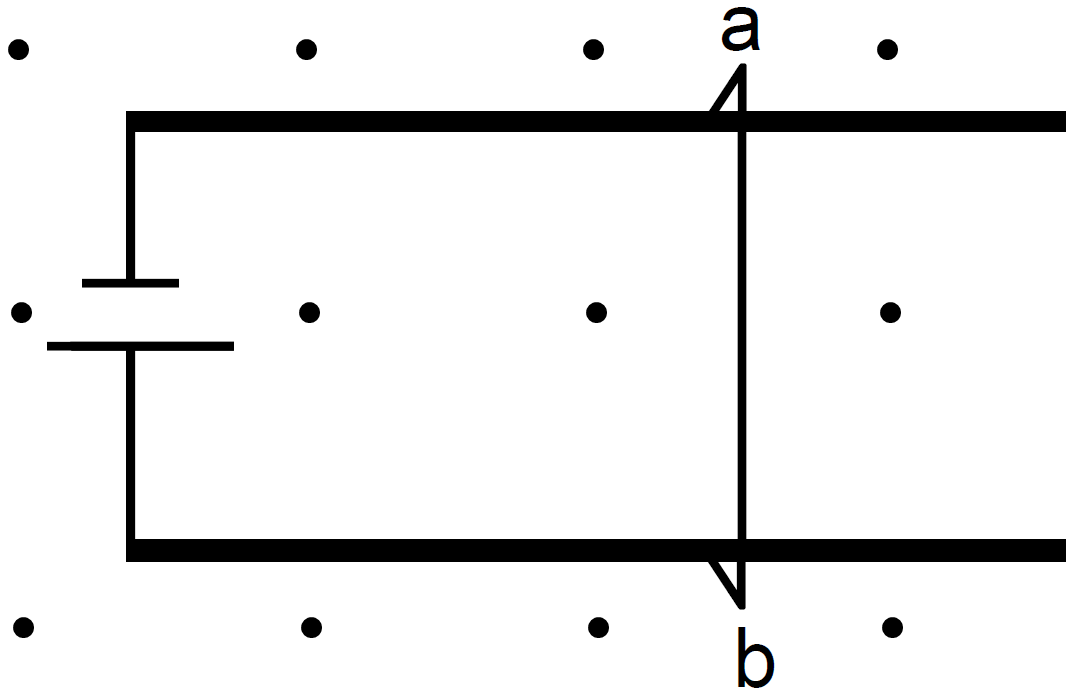
Figure shows a smooth pair of thick metallic rails connected across a battery of $\text{emf} \in$ having a negligible internal resistance. A wire $ab$ of length $l$ and resistance $r$ can slide smoothly on the rails. The entire system lies in a horizontal plane and is immersed in a uniform vertical magnetic field $B.$ At an instant $t,$ the wire is given a small velocity $u$ towards right.
  1. Find the current in it at this instant. What is the direction of the current?
  2. What is the force acting on the wire at this instant?
  3. Show that after some time the wire $ab$ will slide with a constant velocity. Find this velocity.
Why does a solid sphere have smaller moment of inertia than a hollow cylinder of same mass and radius, about an axis passing through their axes of symmetry?
A vessel $A$ contains hydrogen and another vessel $B$ whose volume is twice of $A$ contains same mass of oxygen at the same temperature. Compare $(i)$ average kinetic energies of hydrogen and oxygen molecules $(ii)$ root mean square speeds of the molecules $(iii)$ pressure of gases in $A$ and $B$. Molecular weights of hydrogen and oxygen are $2$ and $32$ respectively.
Find out the increase in moment of inertia I of a uniform rod $($coefficient of linear expansion $\alpha)$ about its perpendicular bisector when its temperature is slightly increased by $\Delta\text{T}.$
  1. Describe a Carnot's cycle.
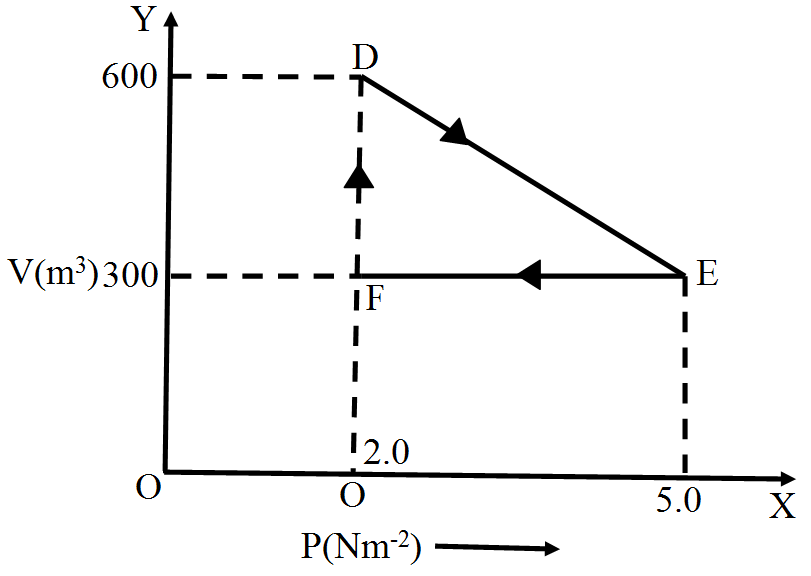
  2. A thermodynamic system is taken from an original state to an intermediate state by the linear process shown in below figure. Its volume is then reduced to the original value from $E$ to $F$ by an isobaric process. Calculate the work done by the gas from $D$ to $E$ to $F$.
The spring constant of the spring shown in figure is $250N/m.$ Find the maximum compression of the spring.
Two open tubes, whose length are 50 cm and 50.05 cm respectively. 10 beats are produced in 3 seconds. Find their fundamental frequencies.
