Two simple harmonic motions, as shown, are at right angles. They are combined to form Lissajous figures
$x\left( t \right) = A\,\sin \,\left( {at + \delta } \right)$
$y\left( t \right) = B\,\sin \,\left( {bt} \right)$
Identify the correct match below
JEE MAIN 2018, Diffcult


Download our appand get started for free
Experience the future of education. Simply download our apps or reach out to us for more information. Let's shape the future of learning together!No signup needed.*
Similar Questions
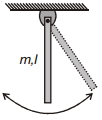
- 1A uniform rod of mass $m$ and length $I$ is suspended about its end, Time period of small angular oscillations is ..........View Solution
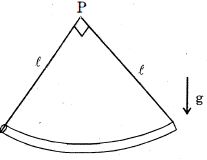
- 2A circular arc of mass $m$ is connected with the help of two massless strings as shown in the figuw in vertical plane. About point $P$, small oscillations are given in the plane of the arc. Time period of the oscillations of $SHM$ will beView Solution
- 3View SolutionIn a simple harmonic oscillator, at the mean position
- 4A $1.00 \times 10^{-20} \,kg$ particle is vibrating under simple harmonic motion with a period of $1.00 \times 10^{-5} \,s$ and with a maximum speed of $1.00 \times 10^3 \,m / s$. The maximum displacement of particle from mean position is .......... $mm$View Solution
- 5A particle executes simple harmonic motion along a straight line with an amplitude $A$. The potential energy is maximum when the displacement isView Solution
- 6A particle executes linear simple harmonic motion with an amplitude of $2\, cm$. When the particle is at $1\, cm$ from the mean position the magnitude of its velocity is equal to that of its acceleration. Then its time period in seconds isView Solution
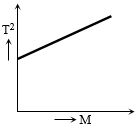
- 7The graph shown was obtained from experimental measurements of the period of oscillations $T$ for different masses $M$ placed in the scale pan on the lower end of the spring balance. The most likely reason for the line not passing through the origin is that theView Solution
- 8A body is executing $S.H.M.$ When its displacement from the mean position is $4\, cm$ and $5\, cm$, the corresponding velocity of the body is $10 \,cm/sec$ and $8\, cm/sec$. Then the time period of the body isView Solution
- 9An oscillator of mass $M$ is at rest in its equilibrium position in a potential $V\, = \,\frac{1}{2}\,k{(x - X)^2}.$ A particle of mass $m$ comes from right with speed $u$ and collides completely inelastically with $M$ and sticks to it . This process repeats every time the oscillator crosses its equilibrium position .The amplitude of oscillations after $13$ collisions is: $(M = 10,\, m = 5,\, u = 1,\, k = 1 ).$View Solution
- 10lfa simple pendulum has significant amplitude (up to a factor of $1/e$ of original) only in the period between $t = 0\ s$ to $t = \tau \ s$, then $\tau$ may be called the average life of the pendulum. When the spherical bob of the pendulum suffers a retardation ( due to viscous drag) proportional to its velocity with $b$ as the constant of proportionality, the average life time of the pendulum is (assuming damping is small) in secondsView Solution